

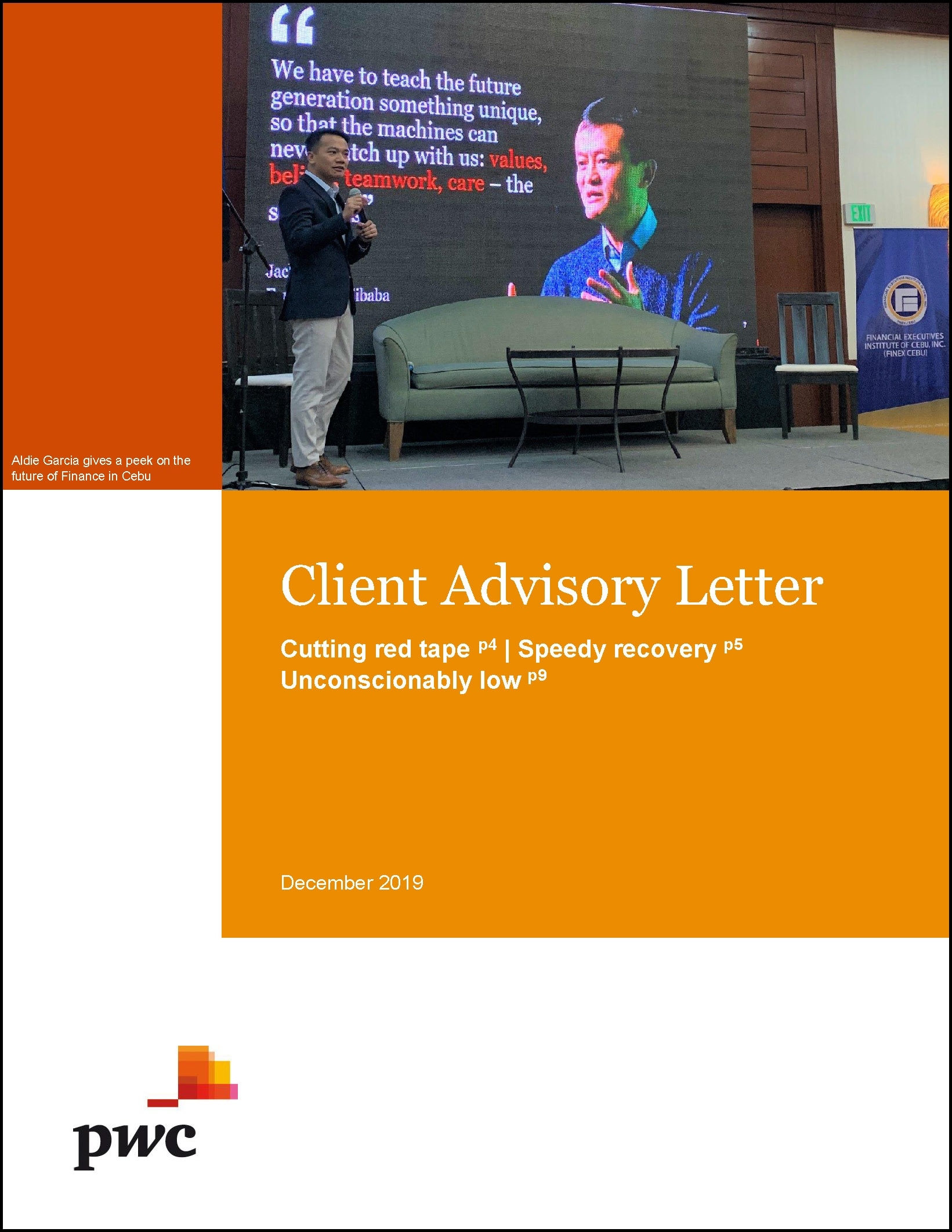
This is a publication about developments in Philippine taxation. The contents usually include latest Republic Acts, Bureau of Internal Revenue issuances, Customs regulations, Court decisions, BSP circulars, SEC circulars, Department of Justice opinions and Executive Orders relevant to Tax practice.
Talk to us
For further discussion on the contents of this issue of the Client Advisory Letter, please contact any of our partners.
Request for copies of text
You may ask for the full text of the Client Advisory Letter by writing our Tax Department, Isla Lipana & Co., 29th Floor, Philamlife Tower, 8767 Paseo de Roxas, 1226 Makati City, Philippines. T: +63 (2) 8845 2728. F: +63 (2) 8845 2806.

Only ten years to achieve Sustainable Development
Businesses remain on starting blocks for integration and progress
Analysis by PwC of over 1000 published reports from listed, private and public sector organisations, highlights that with only ten years to deliver the Sustainable Development Goals (SDGs), there is a great deal of work to be done if business is to contribute meaningfully to national efforts.
PwC’s annual assessment of public reporting on the SDGs assesses the level of integration of the goals into leadership, business strategy and reporting, as an indicator of business’ vital contribution to achieving Government’s stated commitments within the next ten years.
Nearly three quarters (72%) of organizations analyzed reference the goals in their public reporting, just over half in their annual report. Only 1% of the overall sample report quantitative measures to show their progress towards those targets.
It’s now four years since the Sustainable Development Goals were unanimously ratified by all 193 UN Members states as a universal framework for more sustainable ways of living and operating. While Governments around the world have the ultimate responsibility for delivering on the goals, they cannot be achieved without the support of business.
Progress requires specific reporting
Despite good overall awareness, progress on the SDGs could be undermined by a lack of specifics on targets, measurement, and wider business integration. Reporting progress towards the targets needed to achieve the ambitions is very immature, despite the goals offering a common language and framework to build a more transparent view of the issues, progress and scale of change needed. Just 1% of companies analyzed measure their performance against specific SDG targets.
Of the companies analyzed:
- One in five leaders referenced the SDGs in their outlook for the year - demonstrating the goals are moving into the boardroom agenda.
- Of those companies referencing SDGs, 59% referenced them as part of their sustainability report while just over half (51%) mentioned them in their annual report.
- 14% mention specific SDG targets: of those, 39% identify qualitative ambitions, and 20% quantitative ambitions.
- Just 34% of those that mentioned the SDGs (25% of all companies analysed), did so in sections of their reporting that discussed business strategy.
- The majority of companies identify with the goal of Decent Work & Economic Growth as their focus, but goals related to natural resources or wellbeing, critical to sustaining business feature less prominently.
Louise Scott, global lead on Sustainable Development Goals, PwC, says:
“While awareness is high, unless integrated measurement and reporting takes place, progress and relevant policy measures can’t be identified at the level of detail necessary to really drive progress on reaching the goals.”
“Companies are starting to prioritise goals they believe are relevant to them, but we’ve little evidence of joined up thinking on how the goals are approached. Goals related to water, land and energy have strategic opportunities and risks for almost every sector, yet are not widely identified as considerations in future business strategies and investments.”
“The goals are practical. They are both a risk and opportunity management framework from businesses’ point of view. While companies don’t need to specifically reference goals to be acting on them, we should be seeing the identification of issues that underpin them and strategies to address them, and unfortunately we’re not.”
Read the full report here.
Taxes, compliance matters, assessments, and refunds
Local appointment
Establishment of an agent constitutes doing business in the Philippines
In order to qualify for VAT zero rating under Section 108(B)(2) of the Tax Code, the taxpayer must show that its client is a foreign corporation not engaged in business in the Philippines.
A foreign corporation is considered engaged in business if it propagates products in the Philippines and actively participates in several phases of the distribution process. Further, the establishment of a local agent in the Philippines constitutes doing business in the Philippines. Hence, the sale of services to such foreign corporation does not qualify for the VAT zero rate.
(CTA EB No. 1838, promulgated 26 November 2019)
Broad jurisdiction
In a collection case, the CTA may review the validity of an assessment
When reviewing the issuance of a warrant of distraint and/or levy by the Commissioner of Internal Revenue, the CTA’s jurisdiction is not limited to a review of the collection procedure subsequent to the assessment.
The CTA may also review the validity or invalidity of an assessment to determine whether the right of the government to assess and collect taxes already prescribed.
(CTA EB No. 1979, promulgated 26 November 2019)
Take notice
New wording and format of the BIR Notice to the Public
All persons required to issue official receipts and/or sales invoices are directed to post in their places of business, including their branches and mobile stores, the new BIR Notice to the Public. The specific wording and format of the new BIR Notice to the Public are provided under RR No. 10-2019.
(Revenue Regulations No. 10-2019, published on 3 & 13 December 2019)
Cutting red tape
Application for Contractor’s Final Payment Release Certificate no longer required
Since a tax clearance already serves as proof of the full and timely payment of taxes and is a mandatory requirement for the procurement of infrastructure projects, the BIR does not anymore require the filing/submission of an Application for Contractor’s Final Payment Release Certificate (BIR Form No. 0217).
Accordingly, the provision in RMO No. 12-2015 requiring the filing of BIR Form No. 0217 and the presentation thereof by the BIR to the Department of Public Works and Highways as a requirement for the release of the contractor’s final payment has been revoked and shall no longer be enforced.
(Revenue Memorandum Order No. 57-2019, issued 2 December 2019)
Out of coverage
Taxpayers and Top Withholding Agents not required to withhold the 1% and 2% EWT
Under RR No. 7-2019, top withholding agents (TWAs) refer to taxpayers whose gross sales/receipts or pross purchases or claimed deductible itemized expenses amounted to PH₱12m during the preceding taxable year. TWAs are required to withhold 1% and 2% EWT from their income payments to local suppliers of goods and services, respectively, who are not covered by specific EWT rates.
However, Operations Memorandum (OM) Order No. 20-2019 excludes the following in the identification of TWAs even if they have satisfied the criteria under RR No. 7-2019:
- National government agencies, government-owned and -controlled corporations, state universities and colleges, and local government units;
- Taxpayers who were included because of one-time transactions (i.e., estate and donor’s taxes);
- Individual taxpayers deriving income on commission basis such as but not limited to insurance agents and real estate brokers, subject to verification of their duly filed 2018 Quarterly Income Tax Returns in order to determine the regularity of their transactions. Accordingly, if the PH₱12m criteria was satisfied in only one taxable quarter, the taxpayer shall not be qualified as a TWA;
- Taxpayers who are exempt from income taxes without proprietary activities (i.e., foundations,
non-stock, non-profit and tax-exempt educational institutions, religious and charitable institutions, etc.)
Accordingly, the following cannot be compelled to withhold the 1% and 2% EWT under Section 2.57.2(I) of RR No. 2-1998 despite their inclusion in the published list of TWAs:
- Taxpayers whose gross sales/receipts or pross purchases or claimed deductible itemized expenses did not amount to PH₱12m during the preceding taxable year; and
- The above taxpayers enumerated under OM Order No. 20-2019.
(Revenue Memorandum Circular No. 143-2019, issued 27 December 2019)
Waiver form
Basic requirements for the execution of waivers of the defense of prescription
The BIR reiterated the following salient points with respect to the proper execution of waivers of the defense of prescription and the basic requirements thereof:
- The waiver is a unilateral and voluntary undertaking which shall take legal effect and be binding on the taxpayer immediately upon his execution thereof;
- The waiver need not specify the type of taxes to be assessed or the amount thereof;
- It is no longer required that the delegation of authority to a representative be in writing and notarized;
- The taxpayer cannot seek to invalidate the waiver by contesting the authority of its own representative;
- It is the duty of the taxpayer to submit its waiver to the officials listed in RMO No. 14-2016 prior to the expiration of the right to assess or to collect, as the case may be;
- In addition to the previously authorized officials, the Revenue District Officer or Group Supervisor as designated in the LOA or MOA can accept the waiver;
- The date of acceptance by the BIR Officer is no longer required to be indicated for the waiver’s validity;
- The taxpayer shall have the duty to retain a copy of the submitted waiver;
- Notarization of the waiver is not a requirement for its validity;
- The taxpayer is charged with the burden of ensuring that his waiver is validly executed when submitted to the BIR. Thus, the taxpayer should ensure that its waiver:
- Is executed before the expiration of the period to assess or to collect taxes;
- Indicates the expiry date of the extended period;
- Indicates the type of tax (for waiver of the prescriptive period to collect); and
- Is signed by his authorized representative;
- There is no strict format for the waiver. The taxpayer may utilize any form which will have no effect on its validity.
(Revenue Memorandum Circular No. 141-2019, issued 20 December 2019)
Speedy recovery
How to recover erroneously deducted DST under the eDST system
Taxpayers-users of the Electronic Documentary Stamp Tax (eDST) System with erroneously deducted DST amounts from their ledger balances may recover the same by filing a request for adjustment if the following are satisfied:
- Proper accomplishment of the revised BIR Form No. 2000, more particularly, on the tax computations for the eDST System (Part II.A and Schedule 1); and
- The erroneously deducted amount has not been declared in Schedule 1 of BIR Form No. 2000.
(Revenue Memorandum Circular No. 142-2019, issued 27 December 2019)
Change in form
Revision of BIR Form Nos. 1601-EQ and 1602Q
The following have been revised in light of the TRAIN law:
- BIR Form No. 1601-EQ (Quarterly Remittance Return of Creditable Income Taxes Withheld)
- BIR Form No. 1602Q (Quarterly Remittance Return of Final Taxes Withheld on Interest Paid on Deposits and Yield on Deposit Substitutes/Trusts/Etc.)
The revised manual returns are already available in the BIR website. However, they are not yet available in the Electronic Filing and Payment System (eFPS) and Electronic Bureau of Internal Revenue Forms (eBIRForms). Accordingly, eFPS and eBIRForm taxpayers shall continue using the existing versions in the eFPS and eBIRForms Package v7.5, respectively, in filing and remitting taxes due thereon.
(Revenue Memorandum Circular No. 139-2019, issued 20 December 2019)
To have and withhold
Publishing the list of additional withholding agents
The BIR has circularized the recently published lists of additional withholding agents for inclusion to and deletion from the list of withholding agents required to deduct and remit the 1% and 2% creditable withholding taxes (CWT) prescribed under Section 2.57.2(I) of
RR No. 2-1998. The obligation to deduct and remit shall continue, commence or cease effective 1 January 2020.
Taxpayers not included in the updated list of withholding agents are deemed excluded and therefore, are not required to deduct and remit the 1% and 2% CWT.
(Revenue Memorandum Circular No. 136-2019, issued 16 December 2019)
Points to ponder
Pointers to consider in availing the tax amnesty on delinquencies
The BIR has reiterated the following in connection with the availment of the tax amnesty on delinquencies:
- The tax amnesty can be availed of even if there is no FAN/FLD/FDDA that has become final and executory, if:
- The tax liabilities are related to pending criminal cases the DOJ/prosecutor’s office or the courts for tax evasion and other criminal offenses under Chapter II of Title X and Section 275 of the Tax Code; or
- The tax liabilities pertain to unremitted tax withheld by withholding agents.
- When a criminal charge pertains to “failure to obey summons”, the legal officer requires the examiner to issue an assessment based on best evidence obtainable. If an assessment has already been issued as of 21 April 2019, whether final or not, the basis of the tax amnesty would be the basic tax per such document. Otherwise, the taxpayer cannot avail of the tax amnesty on delinquencies.
- Open stop-filer cases are not covered by the tax amnesty on delinquencies.
- PAN, NIC, or equivalent document is sufficient document to support the tax liabilities pertaining to unremitted taxes withheld. “Equivalent document” refers to any of the following issued on or before
24 April 2019 involving 2017 and prior years: - The following must be strictly complied with:
- Tax Amnesty Return (TAR) (BIR Form No. 2118-DA) completely and accurately accomplished and made under oath;
- Acceptance Payment Form (APF) (BIR Form No. 0621-DA) must be duly endorsed by the concerned BIR Officials;
- Certificate of Tax Delinquencies must be issued and signed only by the authorized BIR officer and not by the taxpayer who is availing of the tax amnesty.
- The immunity and privileges shall only apply to the particular tax type and taxable period as indicated in the TAR and paid under the duly approved APF. Consequently, tax liabilities for taxable period/s and/or tax type not included in the tax amnesty application will not be cancelled.
- The Notice of Issuance of Authority to Cancel Assessment shall be issued by the BIR within 15 calendar days from submission of the APF and TAR. Otherwise, the stamped "received" duplicate copies of the APF and TAR shall be deemed as sufficient proof of availment.
- BIR revenue officers are instructed to deal only with taxpayers themselves or their tax agents duly accredited with the BlR. Taxpayers are likewise advised to secure only the services of tax agents included in the list accredited tax agents as posted in the BIR website or the services of bona fide tax lawyers.
(Revenue Memorandum Circular No. 135-2019, issued 11 December 2019)
Exempt return
Newly-revised BIR Form No. 1702-EX
The BIR has revised BIR Form No. 1702-EX (Annual Income Tax Return for Corporation, Partnership and Other Non-Individual Taxpayer Exempt Under the Tax Code). This includes both the Optional Standard Deduction and itemized deductions which are available to be claimed by General Professional Partnerships.
The revised manual return is already available in the BIR website. However, it is not yet available in the Electronic Filing and Payment System (eFPS). Accordingly, eFPS taxpayers shall use the Offline eBIRForms Package v7.5 in filing the return.
(Revenue Memorandum Circular No. 134-2019, issued 5 December 2019)
Freedom of information
Revised People's Freedom of Information Manual
The BIR released the Revised People’s Freedom of Information (FOI) Manual of the BIR, including the following annexes:
- The List of FOI receiving offices and their respective FOI Receiving Officers
- FOI request process flowchart
- List of exceptions
(Revenue Memorandum Circular No. 128-2019, issued 29 November 2019)
Acceptance payment
Providing a new tax type code under the estate tax amnesty
The BIR has provided a new tax type code for the acceptance payment form 0621-EA Estate Tax Amnesty as follows:
BIR Form No. |
Form Description |
Tax Type |
Tax Type Description |
ATC |
0621-EA |
Acceptance Payment Form Estate Tax Amnesty |
ES |
Estate Tax |
MC320 |
Accordingly, all Authorized Agent Banks are advised to accept BIR Form No. 0621-EA (September 2019 version) with its corresponding tax type as the payment form for the Estate Tax Amnesty.
(Bank Bulletin No. 2019-24, dated 9 December 2019)
Latest on regulatory landscape
Alien employment
Rules and procedures governing foreign nationals intending to work
The CoC has disseminated Joint Memorandum Circular No. 1-2019 issued by the DOJ, DFA, DOF, DOLE, DENR, BIR, BI, PRC and NICA containing the Rules and Procedures Governing Foreign Nationals Intending to Work in the Philippines (the “Rules”).
The Rules govern the issuance of the following:
- Alien Employment Permit by the DOLE
- Special Temporary Permit by the PRC
- Special Work Permit, Provisional Work Permit and, 9(g) visa by the BI
- 9(g) and 47(a)2 visa by the DFA
- Authority to Employ Alien and 47(a)2 visa by the DOJ
- Authority to Hire Foreign National by the DENR
They also provide for:
- Options in securing the 9(g) visa
- Duties of concerned government agencies after the issuance, denial or cancellation of the above permits and/or authority
- Requirement to secure a Taxpayer Identification Number
- Requirement to secure a Certificate of No Objection from the DOLE
(Customs Memorandum Circular No. 272-2019, dated 2 December 2019)
Clear timelines
Processing of goods declaration from lodgment to issuance of FAN
Sections 3 and 4 of CMO No. 39-2019 have been amended to clarify the timelines prescribed from the filing of the goods declaration up to the assessment process, and to ensure compliance therewith.
(Customs Memorandum Order No. 52-2019, filed 10 December 2019)
European standard
Implementation of the Registered Exporter System
The CoC issued guidelines for the implementation of the Registered Exporter System (REX) in order to establish a mechanism for the registration of exporters, producers and manufacturers as “Registered Exporters”, to simplify export formalities, and to facilitate application and provide procedures on how to qualify under the REX.
REX is a system established by the European Union which allows a Registered Exporter to self-certify the preferential origin by accomplishing a Statement on Origin under Generalized System of Preference (EU-GSP) on the invoice or other commercial document identifying the exported products.
(Customs Memorandum Order No. 50-2019, filed 4 December 2019)
Box No. 41
Mandatory information in the lodgment of goods declaration
The CoC has issued specific guidelines for the proper accomplishment of the supplemental units under Box No. 41 of the Goods Declaration in the Electronic to Mobile System (e2m). These guidelines cover the lodgment of goods declaration under consumption entry for HS codes mentioned in Annex “A” of CMO No. 49-2019, and include the following:
- The mandatory requirement of filling up Box No. 41 shall cover the chapters indicated in said Annex “A”;
- Annex “A” enumerates the commodities under the
6-digit tariff line (HS Code subheading) of the ASEAN Harmonized Tariff Nomenclature; - The declarant shall be responsible in the proper and accurate lodgment of the supplemental unit or the total numbers of pieces indicated in Box No. 41;
- In case of multiple commodities falling under a similar tariff heading, the declaration shall be itemized per commodity description; and
- The assessment of goods per piece shall be computed by multiplying the customs value with the number declared in the Box No. 41 of the e2m goods declaration.
(Customs Memorandum Order No. 49-2019, filed 8 November 2019)
Good governance
Guidelines on product oversight and governance in life insurance companies
The IC issued guidelines on product oversight and governance which are applicable to all life insurance companies doing business in the Philippines. The guidelines include the following:
- Set-up of a management-level committee with oversight and governance over insurance products
- Oversight of internal processes, organizational arrangements, functions and strategies
- Clearly defined business strategy and risk appetite
- Submission of annual inventory of all insurance products approved by the IC including discontinued products
- Maintenance, operation and review of the product approval process
- Specification of an identified target market for each insurance product
- Testing of insurance products including the use of scenario analyses where relevant
- Careful selection of distribution channels appropriate for the target market
- Regular review of insurance products taking into account any event that could materially affect potential risk to the identified target market
(IC Circular Letter No. 2019-71, dated 17 December 2019)
Unconscionably low
Right of the BOC to compulsorily acquire imported goods
The CoC has the sole authority to exercise Compulsory Acquisition which refers to the power of the government to acquire imported goods when the importer’s declared customs value is unconscionably low with reference to the badges of undervaluation.
In this light, the CoC issued operational procedures regarding the following:
- Issuance of Notice of Compulsory Acquisition
- Conduct of Compulsory Acquisition proceedings
- Issuance of Warrant of Compulsory Acquisition and notice of decision
- Procedure for appeal
- Amount of payment to the importer
- Disposition of goods subjected to Compulsory Acquisition
(Customs Administrative Order No. 16-2019, filed 5 November 2019)
Moving the deadline
Period of registration/notification of operators of payment systems
Operators of payment systems (OPS) operating at the time of the effectivity of RA No. 11127 shall register with the BSP not later than three (3) months from effectivity of BSP Circular No. 1049. Bank or electronic money issuers operating as OPS shall notify the BSP within the same period.
Given that BSP Circular No. 1049 took effect on 1 October 2019, the deadline for the above registration of/notification by OPS, and banks and electronic money issuers was 1 January 2020. However, the Monetary Board extended this deadline to 1 April 2020.
(BSP Circular No. 1068, Series of 2019, dated 26 December 2019)
Outsider restriction
Limitation of foreign ownership in freight forwarding corporations
Freight forwarding corporations are considered operators of public utilities, hence, must comply with the forty percent (40%) foreign ownership limitation. Such limitation does not apply to a freight forwarding corporation engaged exclusively in international freight forwarding.
However, if the freight forwarding corporation will outsource to domestic freight forwarders services relevant to the transportation of goods, the 40% foreign ownership limitation may apply.
(SEC-OGC Opinion No. 19-55, dated 19 November 2019)
Shielding from abuse
Guidelines for the protection of non-profit organizations
The SEC has issued the “2019 Guidelines for the Protection of SEC registered Non-Profit Organizations from Money Laundering and Terrorist Financing Abuse” (the “2019 NPO Guidelines”).
· All non-stock corporations registered with the SEC are required to observe the 2019 NPO Guidelines which provide for the following:
- Risk-based measures
- Promotion of transparency and maintenance of public trust
- Policies on good governance
- Establishment of an audit committee or appointment of an officer or employee to perform audit functions
- Compliance requirements
- Sustained outreach programs and seminars
- Establishment and recording of donors/sources of funds
- Mandatory disclosures
(SEC Memorandum Circular No. 25-2019, dated 27 December 2019)
Code of governance
Code of corporate governance for public companies and registered issuers
The SEC has adopted the Code of Corporate Governance for Public Companies and Registered Issuers which supersedes the following:
- SEC Memorandum Circular No. 6-2009 (Revised Code of Corporate Governance);
- SEC Memorandum Circular No. 9-2014 (Amendment to the Revised Code of Corporate Governance); and
- SEC Memorandum Circular No. 4-2017 (Term Limits of Independent Directors).
All public companies and registered issuers are required to submit:
- A new Manual on Corporate Governance within six (6) months from the effectivity of SEC Memorandum No. 24-2019; and
- A Compliance Officer Certification on the extent of the company’s compliance with the Revised Code of Corporate Governance and Corporate Secretary Certification on record of attendance in board meetings for the covered year 2019 on or before 30 January 2020.
(SEC Memorandum Circular No. 24-2019, dated 19 December 2019)
Alien effects
Implications of foreign ownership in freight forwarding corporations
Corporations engaged in purely international cargo and freight forwarding activities may be wholly-owned by foreigners. On the other hand, corporations engaged in purely local or mixed local and international cargo and freight forwarding activities are subject to the 40% foreign ownership restriction. Violation of such restriction may result in the suspension or revocation of the certificate of registration of the corporation.
Pursuant to the Anti-Dummy Law (Commonwealth Act No. 108), foreigners are restricted from being appointed as officers in corporations with foreign ownership restrictions or those engaged in wholly- or partly-nationalized activities, except for technical personnel authorized by the DOJ. Further, foreigners may be appointed as members of the board of directors or trustees only in proportion to their allowable participation or share in the capital.
(SEC-OGC Opinion No. 19-52, dated 18 November 2019)
Helping helpers
Increase of minimum wages of domestic workers in the NCR
The Regional Tripartite Wages and Productivity Board – NCR increased the monthly minimum wage rate for domestic workers in the NCR from PHP3,500.00 to PHP5,000.00. This applies to all domestic workers such as:
- General house-help
- Yaya
- Cook
- Gardener
- Laundry person
- Any person who regularly performs domestic work in one household on an occupational basis
Family drivers and persons who perform work occasionally or sporadically and not on an occupational basis are not covered.
The above minimum monthly wage rate shall take effect fifteen (15) days after publication of the subject Wage Order in a newspaper of general circulation.
(Wage Order No. NCR-DW-02, approved 28 November 2019)





Follow PwC Philippines


