


From creative strength to greater value
ASEAN's creative economy contributes to economic activity, employment, and cultural influence across the region.
Across film, animation, game development, fashion, and performing arts, ASEAN brings together rich cultural assets, creative and technical talent, production capabilities, a large consumer market, and an expanding digital economy.
The opportunity now is to translate these strengths into greater and more sustainable economic value, including by strengthening the pathways through which creative products, services, and intellectual property are financed, commercialized, distributed, and scaled.
As a Knowledge Partner of the ASEAN Business Advisory Council (ASEAN-BAC), Isla Lipana & Co./PwC Philippines led a study of five priority creative sectors across ASEAN Member States: film, animation, game development, fashion, and performing arts. Drawing on desktop research, expert and stakeholder consultations, and a stakeholder insight survey, the study examines the landscape, enabling conditions, and opportunities and constraints shaping these sectors.
The findings highlight opportunities to strengthen value creation and capture and identify where regional cooperation can complement national efforts to build a more connected and competitive creative economy across ASEAN.
Five messages emerge
1. ASEAN has a strong creative base
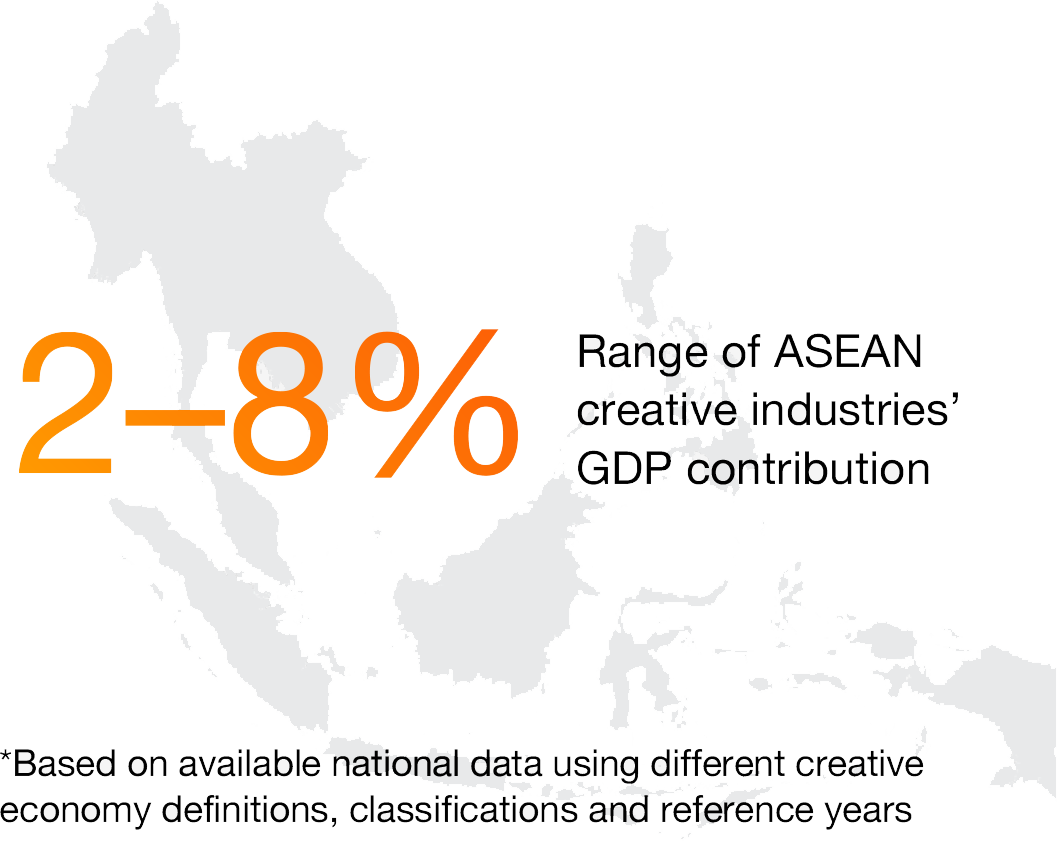
Culture, talent, MSMEs, and production capabilities already generate economic and social value across ASEAN. Their contribution extends beyond GDP to employment, entrepreneurship, trade, tourism, manufacturing, digital services, and intellectual property.
The region's cultural diversity strengthens this foundation. Its stories, traditions, languages, design, craft, and performing traditions provide distinctive inputs for creative products and experiences with regional and global potential.
What this tells us: ASEAN already has a diverse and valuable creative base. The opportunity is to capture more value from it.
2. Digitalization is expanding the market

Streaming, e-commerce, social commerce, digital ticketing, social media, and AI are opening up new audiences, channels, and business models for ASEAN's creative industries.
Digitalization can lower some barriers for creative MSMEs, expand access to regional and international audiences, and create new connections across creative sectors. But greater reach does not automatically translate into stronger competitiveness or greater value capture.
What this tells us: Digitalization is expanding the market, but creative businesses need the capabilities and commercial pathways to turn reach into sustainable value.
3. Value capture remains uneven
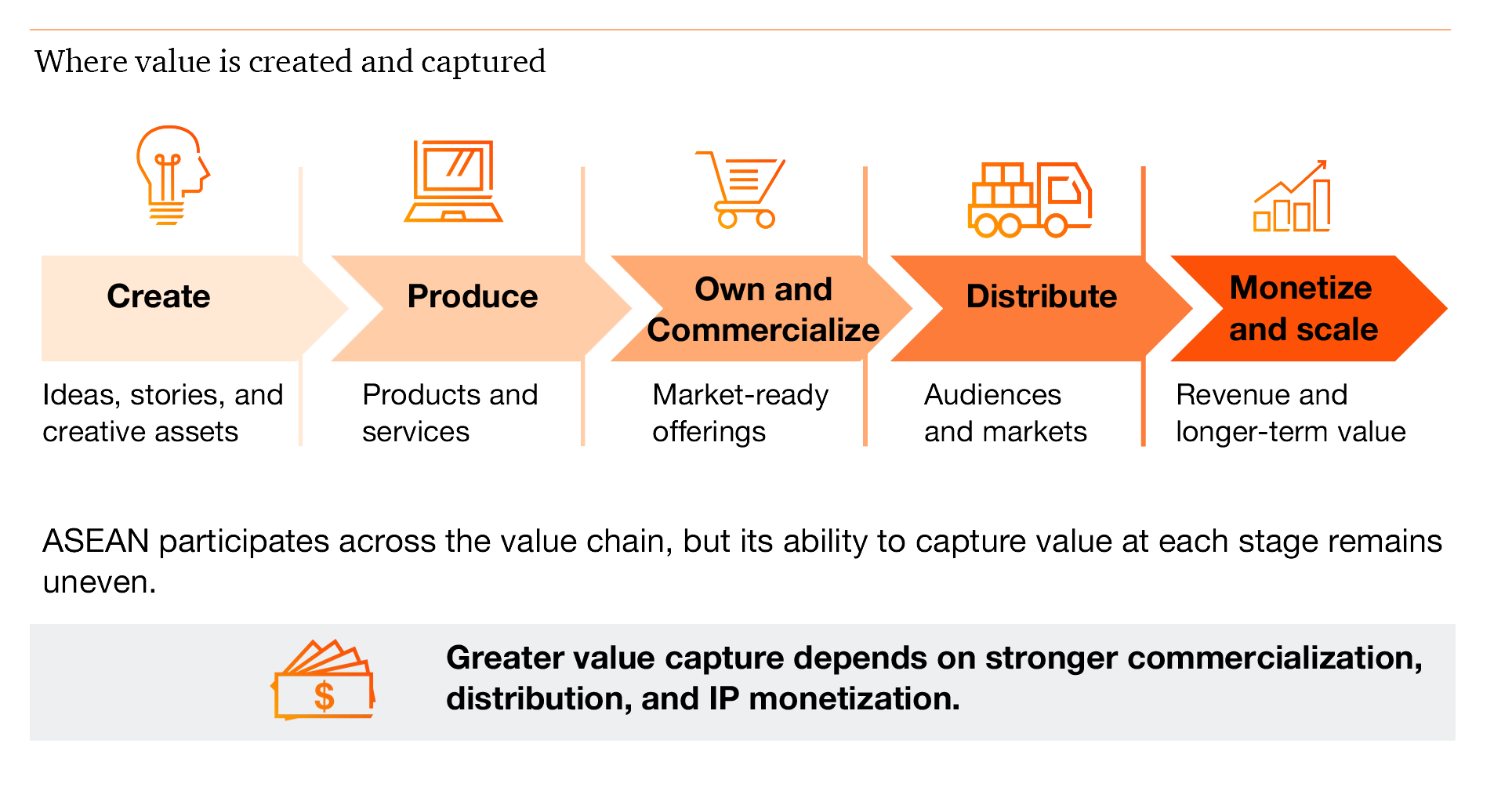
ASEAN has significant creative talent and production capabilities, but pathways for commercialization, distribution, and IP monetization remain uneven. Creating creative products and services and capturing more of their economic value are not the same.
The opportunity is to complement ASEAN's production strengths with stronger pathways for IP ownership and monetization, diversified revenues, distribution, and market access.
What this tells us: More creative activity alone will not maximize economic returns. Stronger commercialization, IP, and market access capabilities can help ASEAN creators and enterprises capture more of the value they create.
4. The constraint is systemic

No single constraint defines ASEAN's creative sectors. Access to finance, fiscal incentives, and public support varies across Member States and sectors. IP enforcement and rights management also vary across the region. Capability gaps extend beyond creative and technical skills to entrepreneurship, financial literacy, digital capability, IP knowledge, branding, and internationalization.
Because these challenges are interconnected, realizing the creative economy's full potential requires coordinated attention to the broader ecosystem around creative enterprises.
What this tells us: Policy interventions should consider how finance, skills, technology, IP, and market access work together.
5. ASEAN can connect the ecosystem
ASEAN Member States have different levels of scale, sector development, specialization, institutional capacity, and access to resources. A one-size-fits-all regional model is therefore neither practical nor necessary.
Regional cooperation can complement national development by connecting capabilities and opportunities across borders, enabling Member States to build on their distinct strengths while benefiting from complementary capabilities elsewhere in ASEAN.
What this tells us: ASEAN's opportunity is not to make every creative economy identical, but to connect complementary strengths and create greater value together.
What the five sectors tell us
While the five creative sectors operate across distinct markets and value chains, together they illustrate where ASEAN's creative strengths are generating economic value and where opportunities exist to capture more of it.

The opportunity ahead
ASEAN begins from a position of creative strength. Its culture, talent, enterprises, and production capabilities already generate economic and social value. The next opportunity is to convert more of this creative activity into sustainable economic value.
This is not about imposing a single model across 11 different economies. It is about connecting different strengths, capabilities, and starting points so that regional collaboration adds value where acting together can achieve more than national efforts alone.
ASEAN Creative Industries Research Paper
Download the full report (PDF, 328 pages)


Contact us



Mary Jade T. Roxas-Divinagracia, CFA, CVA
Deals and Corporate Finance Managing Partner, PwC Philippines
Tel: +63 (2) 8845 2728

Janesse C. Galicia-Dorado
Deals and Corporate Finance Director, PwC Philippines
Tel: +63 (2) 8845 2728

Follow PwC Philippines


