


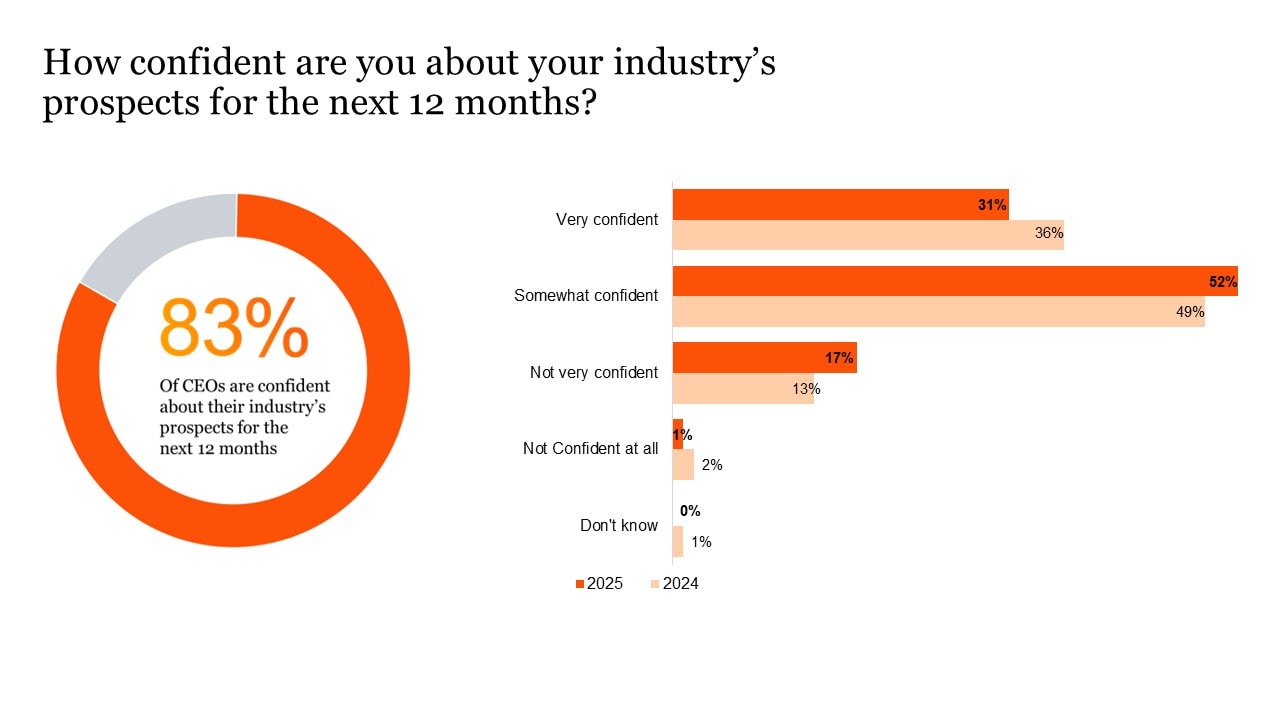
The year 2025 began on uncertain footing as the International Monetary Fund (IMF) revised its GDP growth forecast for the Philippines, lowering it from 6.1% to 5.5%. At the same time, a survey revealed that 74% of Filipinos viewed rising commodity prices as a major concern, while 82% expressed dissatisfaction with the government’s handling of the issue. In January, the country’s sovereign debt reached a record high of PHP16.3 trillion, underscoring fiscal pressures and raising sustainability concerns. Despite these challenges, business confidence remains strong: 83% of the CEOs who answered our survey are optimistic about their industry’s prospects over the next 12 months, while 84% anticipate revenue growth for their companies within the same period. Looking further ahead, 87% expect their companies to achieve revenue growth over the next three years. What’s driving this sustained optimism among CEOs despite the prevailing challenges?
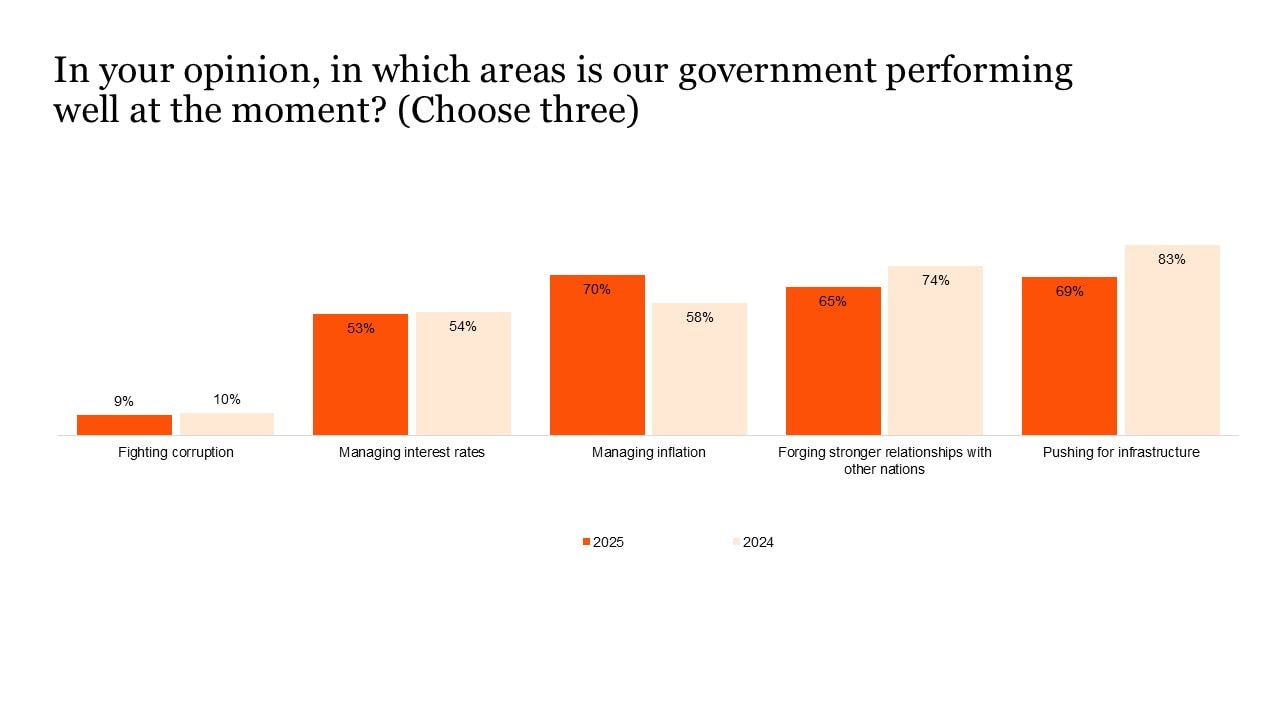
At the macroeconomic level, optimism is fueled by the country’s strong performance. Although slightly below the government’s target of 6-6.5%, the Philippines remains a leading economy in Southeast Asia, ranking third in GDP growth for 2024 with a rate of 5.7%. This growth was largely driven by the accelerated rollout of public works and infrastructure projects under the Build Better More program. The surge in infrastructure activity, supported by strategic public-private partnerships, not only boosted the construction sector by 10.3% but also served as a vital engine of national economic growth.
Other significant contributors to the economy include higher household consumption, wholesale and retail trade, construction, and gross capital formation. Household consumption increased due to steady labor income growth and gradually easing food inflation. The revival of tourism further strengthened the hospitality, dining and transport sectors, which in turn stimulated both public and private construction projects.
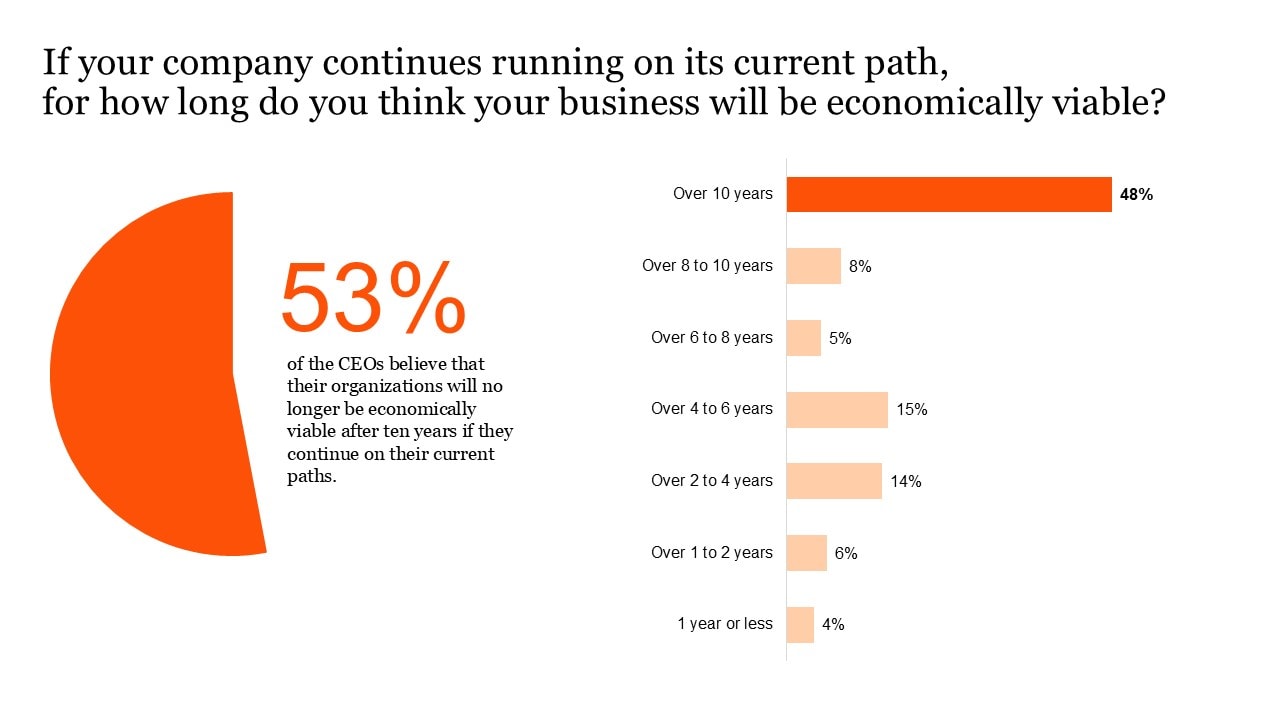
This year, there’s a growing sense of urgency among business leaders in the Philippines. More than half—52%—believe that their organizations won’t remain economically viable after ten years if they continue on their current paths. That’s a notable jump from last year’s 46%, highlighting the mounting pressure to innovate, transform and future-proof their businesses.
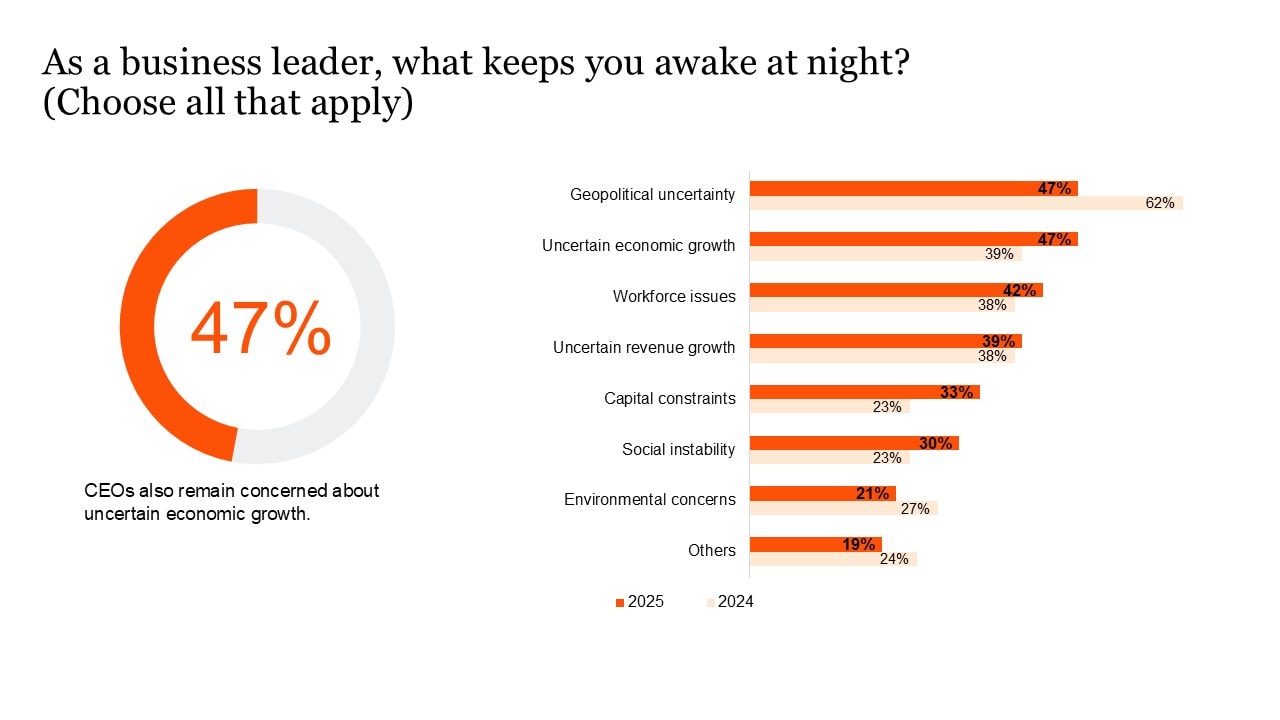
What’s driving this urgency? Megatrends like technological disruption and climate change are shaking the confidence of CEOs based in the Philippines. While leaders recognize that embracing technology is essential, investments in innovation are still falling behind. Many also struggle with a shortage of skilled talent and the right technological capabilities. On top of that, the escalating pace of climate change brought on by frequent extreme weather and natural disasters is damaging infrastructure, disrupting supply chains and driving costs up.
The pressure to reinvent isn’t going away anytime soon. For today’s leaders, the challenge is clear: they must not only respond to change but also take the lead in shaping the future.
For CEOs in the Philippines, AI is now a key part of how decisions get made. It quickly analyzes different scenarios and brings fresh options to the table, expanding boardroom conversations. But experience still matters—it adds the nuance needed to read the context, anticipate risks and gauge what the market will truly accept. The real challenge isn’t whether to use AI anymore; it’s knowing when to let AI take the lead and when to rely on your own judgment. Finding that balance is what effective leadership looks like in today’s constantly changing landscape.
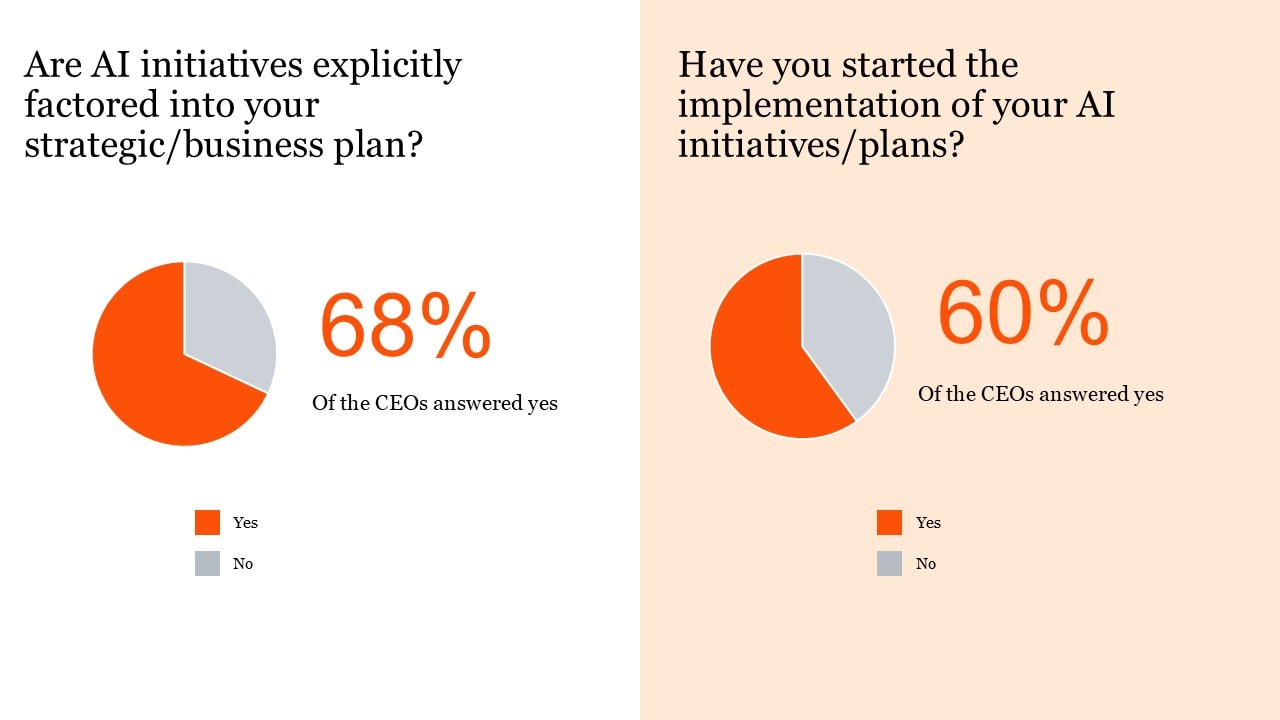
This is evident in our survey, where 68% of CEOs report explicitly incorporating AI initiatives into their strategic and business plans. Implementation is already in progress for 60% of companies, while 40% are still in the planning phase—highlighting significant potential for acceleration. Ultimately, the speed and scale of AI adoption will be the key factors that distinguish the leaders in the next wave of AI-driven growth.
Ongoing disruptions, from economic headwinds to technological advancements in AI, are prompting our business leaders to recalibrate their decision-making processes. Nearly 50% of CEOs have introduced shorter decision timelines and more frequent strategy reviews, reflecting a shift toward structured agility. Teams are actively embedding feedback loops, clarifying ownership and setting clear escalation paths to ensure decisions are both fast and sound.
The goal is to create a reliable rhythm that gets teams working efficiently and speeds up project delivery—without sacrificing quality. This way, organizations can automate routine tasks, free up human judgment for the areas that really need it and respond swiftly when the stakes are high. Together, these practices form the core of the modern CEO playbook: leading with confidence, adapting on the fly and turning disruption into lasting momentum.
Chapter 1 The CEO pulse


Chapter 2 The invisible disruptions

Chapter 3 The intelligence-intuition shift

Chapter 4 The new CEO playbook


Subscription
Join our mailing list



Contact us



Vice Chairman and Assurance Managing Partner, PwC Philippines
Tel: +63 (2) 8845 2728

Karen Patricia Rogacion
Deals and Corporate Finance Partner, PwC Philippines
Tel: +63 (2) 8845 2728

Mary Jade T. Roxas-Divinagracia, CFA, CVA
Deals and Corporate Finance Managing Partner, PwC Philippines
Tel: +63 (2) 8845 2728
Follow PwC Philippines


