

Africa's business leaders demonstrate striking optimism forged through years of navigating currency fluctuations, political uncertainty, and infrastructure challenges.
This confidence is clear when examining their outlook:
This optimism, however, needs to fuel the strategic reinvention essential for future success. While CEOs in Africa have mastered operational resilience, they must now prioritise proactive reinvention alongside reactive management.
With AI, climate change, and geopolitical shifts reshaping entire industries at an unprecedented pace, the ability to reinvent has become the defining capability.

"The uncertainty we all live with today needs to be accepted as the new norm. Every business must find a way to navigate this uncertainty, along with the risks and opportunities it brings. This reality fundamentally challenges how we think about strategy. Strategies cannot be static—they need to be responsive to unforeseen changes, enabled to adapt quickly, and designed with the agility and flexibility to ensure business models aren't compromised when major disruptions occur."
Strategic innovation: Bridging intent and implementation
The ambition: 55% of Africa's CEOs say innovation is critical to their overall business strategy.
The reality: The foundations for systematic innovation reveal significant development opportunities:
- Only 16% operate dedicated innovation centres or incubators
- Just 13% are willing to tolerate high risk in innovation projects
- 29% test new ideas rapidly with customers or end-users
To what extent do each of the following statements characterise your company's approach to innovation?

The impact: The opportunity is clear: CEOs have the ability to drive innovation, but without dedicated structures, increased risk appetite, and rapid feedback loops, innovation remains reactive rather than embedded as a transformative capability.
To translate innovation intent into results, leaders must reposition innovation as a growth engine, create dedicated spaces for transformative ideas, and define strategic priorities that concentrate innovation efforts effectively.
Investment strategy: Balancing caution with transformation
The ambition: CEOs seek to pursue strategic growth through diversification, with 34% having competed in new sectors over the past five years with 24% of their revenue now derived from these newer ventures.
The reality: Despite this diversification success, investment appetite reveals an opportunity to accelerate transformational growth:
- 59% of CEOs indicated little to no change in investment likelihood
- 26% decreased their likelihood to invest
- Only 8% willing to increase large investments despite identifying opportunities
Compared to last year (2024), how has geopolitical uncertainty (including tariffs) impacted your company's likelihood of making new, large investments?
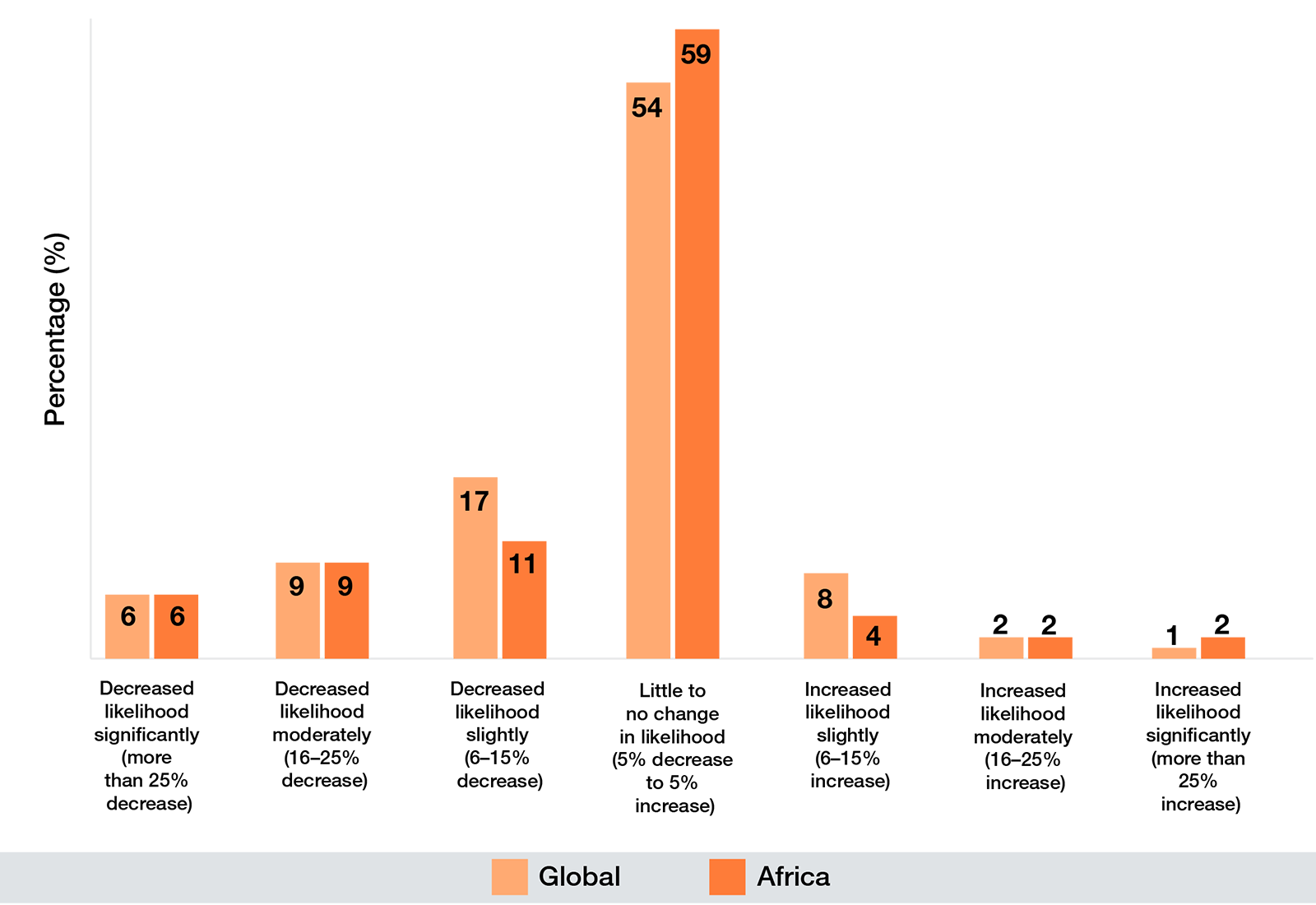
The impact: This extends to acquisitions—only 40% are actively planning acquisitions within three years, compared to 46% globally. Leadership attention compounds the challenge—51% of CEOs focus on activities under one year, while 15% direct attention toward five-year planning.
Despite the fact that CEOs recognise valuable strategic opportunities, if their investment appetite remains unchanged, these numbers won't translate into the transformational growth that Africa's businesses need. Strategic acquisitions offer pathways to accelerate innovation through cutting-edge technology, intellectual property, and specialised capabilities—growth trajectories that would otherwise take years to develop organically.
AI: A transformation case study
The ambition: AI dominates boardroom discussions across Africa. CEOs seek to leverage AI as a transformative tool, with 75% demonstrating a strong commitment to AI adoption last year.
The reality: Despite strong commitment, leaders in Africa face unique structural and economic challenges when it comes to the implementation of AI.
- Only 41% have clearly defined AI roadmaps
- 37% have formalised responsible AI processes
- Just 26% believe their investment levels are sufficient to deliver business AI goals
To what extent do you agree or disagree with the following statements relating to AI use at your company?

The impact: The competitive gap is evident—Africa's CEOs are lagging global peers in AI deployment across business functions, threatening to widen competitive gaps.
To what extent has AI been applied in the following areas of your business?

AI investment are delivering proven value. 23% of CEOs reported revenue increases and 25% achieved cost reductions. The question isn't whether AI works, but whether current investment positions businesses in Africa for long-term competitiveness as agentic AI emerges.
The path forward
Leadership implication summary:
| Dimension | Current state | Future considerations |
| Risk orientation | Cautious and defensive; prioritising stability over transformation. | Embrace risk as a strategic input; place bolder bets on emerging opportunities. |
| Strategic focus | Leadership attention absorbed by operational demands; limited time on long-term planning. | Institutionalise strategic foresight; protect capacity for future-focused work. |
| Innovation appetite | Innovation recognised as important but lacks systematic foundations. | Create dedicated structures, increase risk tolerance, and build rapid feedback loops. |
| Investment approach | Acquisitions focused on market share and efficiency; constrained by capital access. | Balance core protection with deliberate investment in transformation pathways. |
| Planning mindset | Reliance on static plans that cannot hold in volatile environments. | Adopt adaptability intelligence; combine long-term vision with short-cycle recalibration. |
| Execution confidence | Doubt about ability to transform at pace without destabilising the core. | Build transformation operating models that run the core and build the future in parallel. |
| AI adoption | Pragmatic and selective; infrastructure and governance foundations still developing. | Accelerate investment in infrastructure and tools; embed AI strategy across business with clear accountability. |

"Africa's CEOs are not short on ambition or ability—and they face an extraordinary opportunity. With vast talent pools and a dynamic young population, the continent is uniquely positioned to leapfrog global counterparts by embracing the necessary tools for transformation. What's needed now is decisive and inspirational leadership that matches intent with action."


