Turn insight into action
We help you solve the problems that matter most so you can act faster and move further.
What would you like to explore?
How ready are European manufacturers for the next shock?
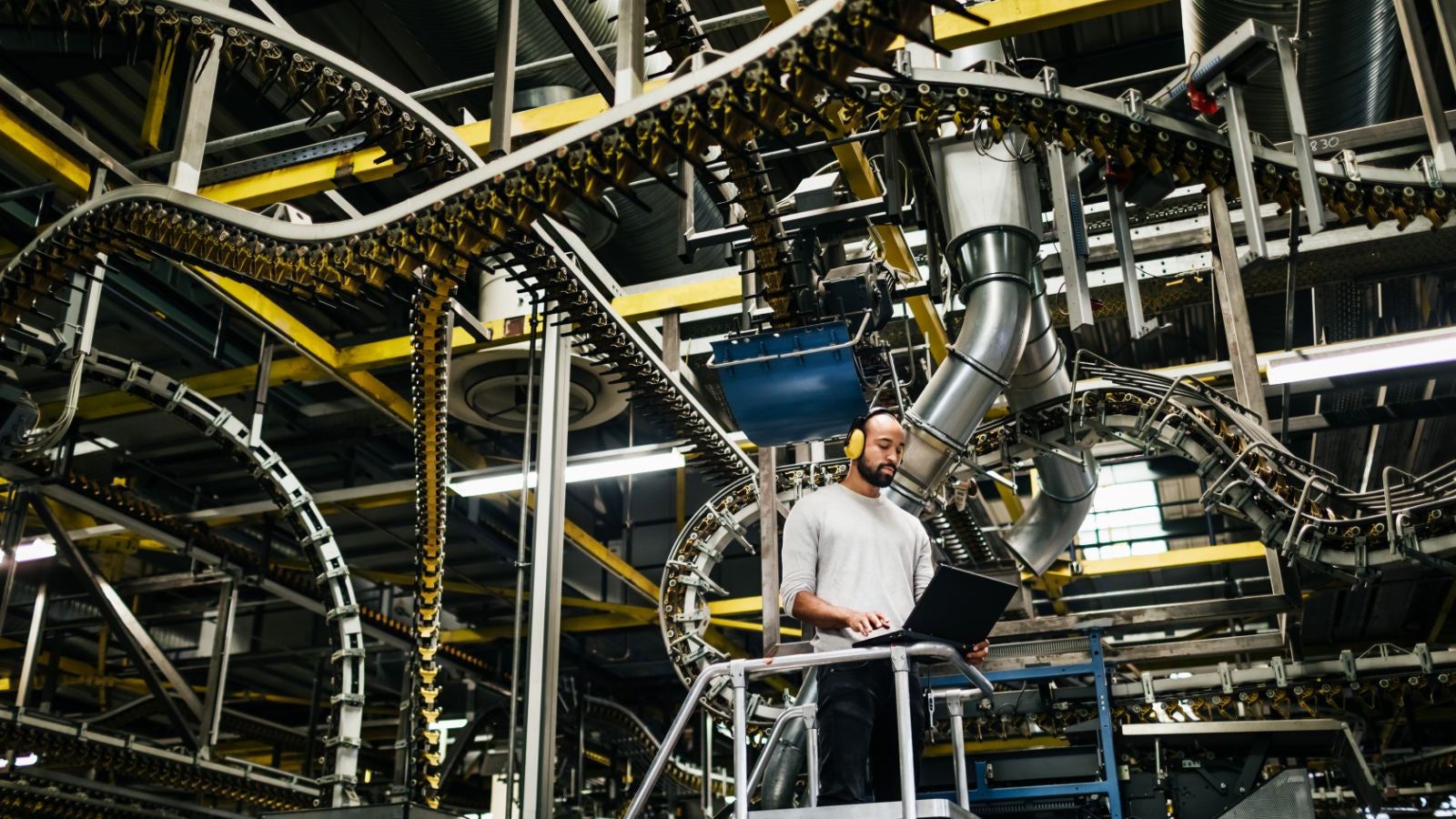
The findings reveal that many manufacturers are not yet equipped to respond effectively to the disruptions they may face in the future.
European manufacturers are operating in an environment characterised by increasingly frequent and complex disruption. Supply chain volatility, geopolitical uncertainty, and operational pressures are testing organisations’ ability to anticipate change, respond quickly, and maintain performance.
This survey assesses readiness to navigate disruption among 200 manufacturing respondents across 10 European territories, and explores how organisations are responding to geopolitical, climate, supply-chain, resource, and regulatory disruption.
The findings reveal that among surveyed respondents, gaps in supply-chain mapping, standardisation and the integration of structural risks suggest potential weaknesses in readiness for future disruption.
Key findings
Five findings define the state of European manufacturing readiness in 2026
-
Finding 1
Companies’ data foundations remain fragmented, limiting visibility and slowing responses to disruption. While 80% of respondents still use spreadsheets and email to track suppliers, only 37% have mapped their multi-tier supply chain. More strikingly, just 24% operate with fully standardised risk data.
-
Finding 2
Half of European manufacturing operations hinge on key individuals, not processes. Around half of respondents report heavy reliance on specific people in the functions assessed. When response capabilities heavily depend on individuals rather than established processes, staff departures may weaken institutional knowledge and make it harder to scale responses across sites or simultaneous disruptions.
-
Finding 3
People’s capacity and management bandwidth is the most frequently cited barrier limiting the ability to future-readiness manufacturing sites. This suggests the main constraint overall is not a lack of ambition, but a failure to create sufficient space to focus on resilience alongside immediate operational priorities.
-
Finding 4
Fewer than half of the respondents consistently integrate climate and long-term structural risks into their operational and investment decisions. This limited integration of key risks reduces companies’ ability to detect emerging disruption early and respond at speed.
-
Finding 5
Short-term priorities often constrain sustained investment in resilience. Although 43% rank resilience among top priorities, 44% identify it as secondary, suggesting trade-offs in management focus.
The “3S model”
Manufacturing readiness: From Signal to Speed through Systems
Readiness isn’t a one-time effort, but an operating capability built on three essential foundations: data, processes and people. When these three elements work together as seamless Systems, organisations can detect the Signals that matter—and then act at the Speed competitiveness demands. When the systems don’t work seamlessly, both signal and speed deteriorate. That forces organisations to make difficult trade-offs between continuity, cost, and compliance. Together, these three capabilities—systems, signals and speed—constitute the “3S model”.
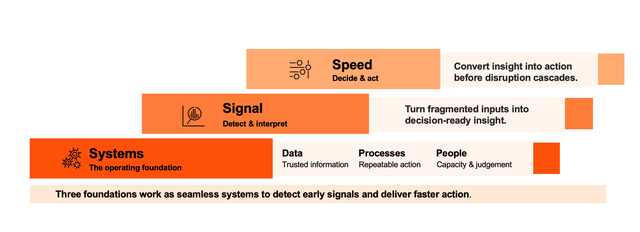
Readiness vs. exposure
We use the 3S model to organise patterns in respondents’ reported readiness and identify possible improvement areas.
- Systems — Data: Stronger readiness starts with standardised, centralised risk data that can be trusted at first read. Greater exposure persists for the 80% who continue to track suppliers through spreadsheets and email resulting in data that requires reconciliation under pressure.
- Systems — Processes: Stronger manufacturers embed response capability in playbooks, decision rights, and escalation protocols. Greater exposure remains for the 50–55% who report heavy dependence on key individuals across functions.
- Systems — People: Stronger manufacturers protect capacity for structural work. More exposed organisations remain trapped in day-to-day priorities, repeatedly deferring resilience and future-proofing.
- Signal: Stronger readiness means consistently embedding climate and structural risk in operational and investment decisions. Roughly half of respondents do so only to some extent or almost never, leaving critical risks outside core decision-making.
- Speed: Stronger manufacturers build options before disruption. They qualify alternative suppliers, measure buffers and create logistics flexibility. More exposed organisations discover dependencies in real time and must make high-pressure trade-offs between continuity, cost, and speed.
As our research underlines, the real test of readiness is whether an organisation has flexibility and optionality. The key question is: to what extent can the organisation change its sourcing, production or logistics model when conditions shift, and does it have feasible alternatives ready to activate? To have optionality when a shock hits, a company needs to have already set up qualified suppliers, alternative routes, inventory or capacity buffers, and clear decision rights. Without these executable choices, the speed of response is constrained, regardless of how quickly a decision is made.
Actions to take across the C-Suite
Our findings point to several specific steps that members of executive leadership should take as a matter of urgency to improve readiness. From defining the options needed to protect strategy and growth, building a scalable operating model to quantify exposure and measure feasibility. These actions– led by the CEO, CFO, COO and Heads of Legal and Trade – could strengthen the organisation’s capabilities and optionality, helping it respond more effectively and manage the impact of future disruption.
Related content

A new imperative for business model reinvention
Explore the necessity of continuous business model reinvention. Learn how customer focus, data insights, and collaboration drive innovation and global growth.
7 min read
The three biggest GenAI priorities for industrial manufacturers
Companies are experimenting with isolated use cases in support functions, but the real value lies elsewhere.
3 min read
AI in operations
Discover how AI is transforming manufacturing by boosting productivity, cutting costs, and driving innovation. Explore insights from 400 global executives.
9 min read
Industrial manufacturing’s race to 2030
Accelerating automation, AI adoption, and stronger ecosystem collaboration will define the winners—and leave others playing catch-up.
26 min read
Global Engineering and Construction Sector Outlook 2026
As E&C firms look towards 2031, growth will depend on their ability to orchestrate capabilities, technology, and partners in more complex delivery systems.
34 min read
Confronting the growth paradox in aerospace and defence
A&D companies are experiencing accelerating growth alongside ongoing delivery challenges. What will it take to manage both?
24 min read
Get in touch

Renate de Lange
EMEA Sustainability Leader, Partner
PwC Netherlands

Stefan Schrauf
EMEA and German Business and Supply Chain Operations Leader, Partner
PwC Germany

Matthieu Lemasson
EMEA Industrials and Services Leader, Partner
PwC France
