Turn insight into action
We help you solve the problems that matter most so you can act faster and move further.
What would you like to explore?
Confronting the growth paradox in aerospace and defence
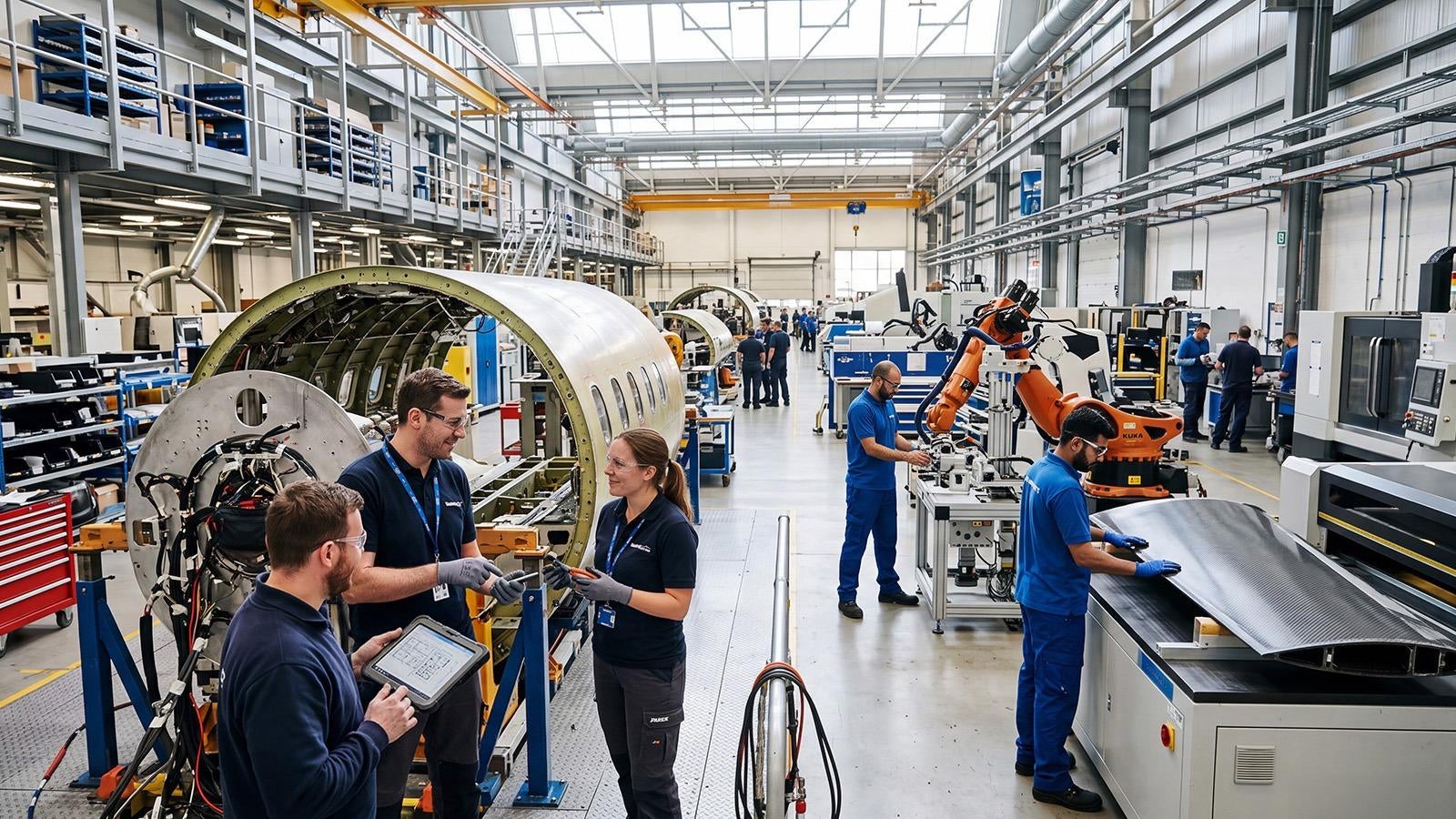
A&D companies are experiencing accelerating growth alongside ongoing delivery challenges. What will it take to manage both?
The takeaways
- Production, supplier, and workforce constraints could turn record A&D demand into a growth bottleneck.
- Deep change is underway, as value shifts towards new markets and customers, software, autonomy, and recurring-revenue models.
- Three distinct growth models are emerging—companies won’t win by focusing on industrial execution or portfolio change alone.
The dilemma
The aerospace and defence (A&D) sector finds itself in a period of extraordinary opportunity—and extraordinary change.
Commercial aircraft orders are running at record levels. Defence budgets and order books are rising. Space has developed into a substantial commercial market. But at the same time, the definition of future demand is shifting. Technology, geopolitics, and changing customer needs are putting value in motion across the global economy—with the movement especially visible in A&D. Value is shifting geographically, across the customer base, up the technology stack, and across industry boundaries.
All of this is landing on a sector already straining to deliver. Order backlogs stretch well into the next decade, supply-chain constraints continue to affect commercial aircraft deliveries, and defence programmes face long development and delivery timelines. Across the industrial base, critical suppliers are dealing with capacity and workforce constraints, while some smaller firms lack the capital and demand certainty needed to invest ahead of rising production.
A recent PwC survey of 375 senior executives—across primary contractors (or ‘primes’); tier 1, 2, and 3 suppliers; maintenance, repair, and overhaul providers (MROs); space companies; and A&D technology providers—shows just how hard it may be to capture the substantial amount of value in motion. Respondents report bullish demand through 2031 while acknowledging that the sources of future value require capabilities much of the industry has yet to build.
The survey points to a two-track response: strengthening the industrial system required to deliver today’s backlog of orders while repositioning portfolios around tomorrow’s value pools. Both tracks require attention and will lean on technology, but a company’s strategic posture will shape how much weight it places on each.
A changing landscape
Four shifts redrawing the A&D market
The A&D market is expanding, but its composition is also changing. Four shifts are reshaping where growth comes from, what customers buy, and which companies are positioned to capture emerging opportunities.
1. Asia is becoming a source of incremental growth
North America, Western Europe, and the Middle East continue to offer the biggest opportunities to aerospace and defence companies, and they’ll keep anchoring the sector for years. But despite all of the activity occurring in the Middle East and Ukraine, executives expect a growing share of incremental demand to come from farther east. By 2031, respondents in both aerospace and defence expect Southeast Asia and South Asia to rise in importance more than any other region. Boeing, for example, expects passenger traffic in both regions to grow about 7% annually through 2045, supporting demand for more than 8,000 new aircraft, while global military spending across Asia and Oceania rose 8.1% in 2025, its fastest increase since 2009. India was the world’s second-largest arms importer in 2021–25, yet it’s reserving roughly three-quarters of its 2026–27 capital-acquisition budget for domestic industry, underscoring how regional growth is increasingly linked to localisation.
2. The customer base is changing—so is what buyers value
The customer mix is shifting in two ways. First, foreign government and public-sector buyers are rising in importance. Second, digital-infrastructure, data, and software providers are joining the government and airline customers that have historically anchored the sector.
Customers are also changing what they value. Operational performance and delivery reliability were each selected as most important by 56% of respondents, followed by core product and mission performance at 51%. Measures of cost predictability and competitiveness ranked considerably lower, particularly for defence respondents. Survey respondents don’t necessarily see customers as indifferent to cost but suggest they appear willing to pay for stronger assurances on delivery, uptime, and performance.
This shift is showing up in companies’ technology investment priorities. Nearly half of respondents (49%) rank digital infrastructure, data, and enterprise platforms—including cloud, data platforms, integration layers, enterprise resource planning (ERP) systems, and digital-thread and digital-twin infrastructure—among their top three value-chain investment priorities, second only to production, manufacturing, and integration at 50%. These investments can connect data across engineering, production, the supply chain, and in-service operations, helping companies improve delivery reliability, uptime, and performance while laying the foundations for AI and automation to help identify issues before they affect the customer.
The responses of A&D technology providers indicate where customer expectations may go next. They’re far more likely than the rest of the sector to identify modularity, upgradeability, and interoperability as critical customer expectations. They’re also twice as likely to name cybersecurity as a top area of investment, a sign of its importance to their businesses and customers. As A&D systems become more software-defined, those expectations are likely to spread across the wider customer base.
3. Value is moving up the stack
In aerospace and defence portfolios, respondents expect AI-enabled and autonomous solutions to rise in importance by 2031. In the space segment, data, software, and analytics gain importance, while ground systems and terminals decline significantly. The physical platform remains essential, but more of its value is being determined by the AI, software, networks, and data surrounding it.
Spotlight on space
Space companies are more technology-forward than their A&D counterparts, and they’re turning those investments into new ways of earning revenue. Nearly half of space respondents (47%) prioritise developing new recurring-revenue models, a figure six percentage points higher than the A&D average. Many examples exist in the market today. BlackSky, for instance, sells defence customers subscription access to satellite imagery and AI-enabled analytics, offering the ability to request and schedule satellite collection over a particular area of interest. Rather than procure and operate the satellite themselves, customers can reserve priority access to its capabilities when they need them. ICEYE offers a similar model for radar imagery. Customers can reserve satellite passes over areas they care about and determine when to use them, with imagery available in less than an hour.
The survey suggests these models could become much more important. The share of space respondents ranking recurring revenue from software, data, analytics, or platform-based solutions among their top-three revenue opportunities rises to 60% in five years from 27% today. Conversely, the portion identifying one-time sales of products, platforms, components, or systems as a top-three opportunity falls to 40% in five years from 75% today. Increasingly, hardware is becoming the infrastructure behind an ongoing service, effectively reshaping the unit of sale.
As the unit of sale changes in the space market, competitive boundaries are shifting with it. Space companies are aware, for example, of how service-based revenue can open them up to new competitors and are more likely than the A&D sector overall to cite entrants from adjacent industries as a competitive pressure.
Amazon Web Services (AWS) provides one example of how technology companies are moving into the space ecosystem. Its Ground Station service lets satellite operators buy antenna time by the minute to communicate with spacecraft and downlink data, rather than build and operate their own networks on the ground. The data can then move directly into AWS cloud infrastructure for processing and distribution. Meanwhile, many space companies are planning to expand outwards themselves, with 73% expecting to move into adjacent offerings and 71% aiming for greater ecosystem participation.
The result is a market in which the boundaries between space, technology, and services are becoming increasingly fluid.
4. The competitive landscape is broadening
As value moves towards software, autonomy, and data, the profile of an A&D competitor is also changing. Existing rivals remain the most frequently cited competitive threat, named by 68% of respondents. But emerging defence-exporting nations are second at 49%, reflecting the growth of suppliers in countries such as Turkey and South Korea.
At the same time, technology and software companies have moved from the industry’s periphery to create credible programmes, though established players express less concern about the ones still in the start-up or scale-up phases. But while incumbent companies do retain considerable advantages—such as customer trust, programme experience, regulatory knowledge, systems-integration capability, and long-cycle support—those strengths no longer guarantee control of every layer of the tech stack. In autonomy, data platforms, and AI-enabled mission systems, a winning competitor could come from outside the traditional peer group. Consider the example of Helsing, which progressed from selection for Germany’s Eurofighter electronic-warfare programme in 2023 to a development contract worth hundreds of millions of euros in 2025 to integrate its Cirra AI software into the aircraft.
Next moves for A&D leaders
Growth plans should be tested against where future value is forming, rather than where current revenue is concentrated. That means reassessing geographic footprints, redesigning propositions around outcomes rather than individual products or platforms, determining which parts of the software and data stack to control, and pinpointing where new types of competitors could weaken the company’s position. Companies also need to distinguish between markets that can still be served through exports, those where a local partner provides sufficient access, and those where an enduring presence will be required. The risk is less that leaders fail to recognise market shifts and more that their organisations remain anchored to the market structure they already know.
Scaling production
Growth is testing capacity
The movement of value creates a portfolio challenge, but the sector also faces a more immediate issue: its industrial system is struggling to support the growth already in front of it. Respondents expect to increase capacity by an average of 28% over the next five years, but some major programmes require much steeper ramps. In defence, Lockheed Martin is targeting an approximately 233% increase in PAC-3 missile production capacity over the next seven years. At the same time, governments are signalling further demand growth. In the US, for example, the administration is seeking a 42% increase to its 2027 defence budget.
This demand outlook puts particular pressure on the supply chain, where planned capacity expansion falls off below the prime level. Primes expect the strongest capacity growth over the next five years, at 34%, with Tier 1 firms planning smaller increases and lower-tier suppliers and MROs trailing further behind. This raises the risk that supplier capacity, not market demand, becomes the binding constraint on growth.
GE Aerospace—Idea in motion
Bringing the operating system to the supply base
Production scalability is also a workforce problem. The sector needs more engineers, technicians, machinists, and skilled tradespeople than existing pipelines are likely to produce, and it competes for them with technology companies and other advanced industries. In the US, our previous research found a quarter of the A&D workforce is aged 56 or older and just 7% is under 25, raising the risk that retirements will drain critical experience and institutional knowledge just as companies need to increase output.
Recruitment alone won’t close the gap. Companies will also need to raise the productivity of the workforce they already have. Respondents facing significant skills barriers appear to be turning to technology to help: they’re 2.1 times as likely as other companies to be investing in physical AI solutions, including autonomous inspection, robotics, and automated manufacturing.
However, across the survey respondent base, workforce issues aren’t yet receiving the strategic emphasis required to fully address them. Only 20% of respondents cite workforce capability and productivity as a top-three strategic action for the next five years even though about half named it as a top barrier to delivery.
Next moves for A&D leaders
Capacity doesn’t need to expand across the board, but most A&D companies have imperfect visibility of both the internal choke points and those in the supply chain. Fixing that is the first move. Digital tools can help companies pinpoint bottlenecks across the supply chain and within organisational boundaries, where they can also reduce time lost to rework and quality issues. From there, the bottlenecks themselves need real investment—much of it in tech-enabled capabilities such as digital production systems, model-based engineering environments, automated inspection, and advanced manufacturing.
The second move is choosing the right structural response for each critical supplier. The GE Aerospace example—focusing on a discrete number of priority sites, resourced directly with technical talent—illustrates one model for shoring up supplier capacity. In most cases, longer demand commitments, supplier financing, or co-investment in equipment and digital capability will likely be enough. In other situations—notably those involving fragile suppliers, highly specialised capabilities, or companies subject to sovereignty requirements—vertical integration may be the answer.
Underpinning both responses are moves to make the workforce a much higher priority than respondents currently assign to it. Hiring plans and productivity investment need to be aligned to capacity requirements rather than treated as a downstream HR exercise.
Delivery versus portfolio investments
A two-track growth plan is taking shape
The four most frequently cited strategic actions for the next five years are split almost evenly between two tracks. On the delivery side, respondents point to scaling production capacity and delivery rates and accelerating development and deployment cycles. On the portfolio side, they’re focusing on developing new products or platforms and recurring-revenue models. The near-even split suggests that companies are treating delivery and portfolio moves as parallel programmes rather than sequential ones.
Some of the largest expected increases in technology use occur in the functions most closely associated with the delivery track. Supply-chain and procurement activities are expected to see the biggest rise in technology adoption by 2031, alongside portfolio, programme, and demand management.
The portfolio track involves a substantial change in what companies expect to sell and is also largely tech-driven. Aerospace companies are moving towards autonomous, digital, and lower-emissions offerings. Defence companies are emphasising autonomy, tactical networks, and mission integration. Space companies are shifting towards connectivity, sensing, analytics, and in-orbit services.
Airbus—Idea in motion
Expanding from crewed aircraft to more autonomous systems
These shifts open the door to new commercial models. Executives expect recurring revenue from software, data, and platform-based solutions to become a top opportunity over the next five years, while one-time product sales decline in relevance. For companies with more than US$5 billion in revenue, developing recurring-revenue models is the most frequently cited strategic priority, selected by 59% of these respondents and 18 percentage points above the survey average. While recurring revenue reduces dependence on irregular mandates and aligns the provider more closely with customer outcomes, the commercial model can move only as fast as the delivery track underpinning it.
Few companies can build every capability required for either track internally. Asked how they plan to access their most important growth opportunities, 76% of respondents say they’re looking at strategic collaboration within their ecosystem—which is a few points ahead of developing capabilities internally (71%) and well above acquisitions (35%) and licensing (26%). Defence respondents are especially inclined to pursue collaboration, while the aerospace segment is slightly more likely to focus on developing capabilities internally.
Accessing advanced technologies is the most frequently cited reason for ecosystem participation, selected by 52% of respondents, followed by accelerating innovation and speed to market (48%) and co-developing new products, services, or platforms (48%). The composition of ecosystems is shifting accordingly: respondents expect semiconductor partners to roughly double in importance over the next five years and telecommunications firms to rise by more than half, while traditional collaborators—other A&D companies, industrial manufacturers, and government bodies—decline. Clearly, the partners becoming more central to A&D are the ones supplying the compute, connectivity, and digital infrastructure on which future growth depends.
Lockheed Martin—Idea in motion
Taking an ecosystem approach to airspace protection
Next moves for A&D leaders
Both the delivery and portfolio tracks would benefit from being built on a common technology, data, and investment architecture. Digital twins can identify production risk and support through-life performance management. AI tools can raise engineering productivity and contribute to autonomy-enabled products. Connected product data can improve maintenance planning and support new customer services. Separate architectures result in duplicated cost, fragmented data, and barriers between the operating and commercial sides of the business.
The two tracks should also connect earlier in the product life cycle. New products and platforms should be designed with production scale in mind, bringing operations and manufacturing engineering into development before cost and complexity become difficult to manage.
Not every platform should be shared across every use case—factory, aircraft, and classified mission systems have different requirements—but decisions about data models, integration, cybersecurity, and reusable AI components should be made with the wider enterprise in view. This kind of coordinated view requires closer collaboration among leaders responsible for engineering, operations, technology, products, and services.
Ecosystem choices also need to be made deliberately on both tracks. Partnerships should be assessed according to the capability they accelerate, the dependency they create, and the future value they may transfer. Short-term speed shouldn’t determine the long-term structure of the business. The aim is to use external capability without losing control of the technologies, data, or customer relationships central to the company’s future position.
Strategic archetypes
Three growth models are emerging
Every A&D company faces the same challenge of addressing both tracks, but their strategic posture will determine which receives more emphasis. PwC’s cluster analysis reveals three strategic archetypes: digital systems builders, representing 44% of the sample; industrial powerhouses, 39%; and life-cycle leaders, 17%. Each reflects a different view of where future value will concentrate and which capabilities will matter most.
The archetypes cut across segments, company size, and position in the value chain. For example, some primes behave more like digital systems builders than like other large manufacturers, while some Tier 1 suppliers have a life-cycle services profile. For A&D leaders, understanding the strategic identity of their company—and their competitors—can help them focus investment and capability-building priorities while revealing competitive threats that traditional industry boundaries might obscure.
1. Digital systems builders target growth through software and autonomy
Digital systems builders are placing the sharpest portfolio-track bet. They craft their growth strategies around software, data, autonomy, and next-generation capabilities and focus heavily on establishing recurring-revenue streams. Reshaping what they sell is pulling whom they sell to along with it: digital infrastructure, data, and software providers rise to become a top customer group within the next five years.
Given their tech-focused posture, digital systems builders are far more likely than the other strategic archetypes to see cybersecurity as a threat to the way their company creates, delivers, and captures value over the next five years. Moreover, they see existing competitors as their biggest threat, followed by new market entrants.
Companies in this group certainly aren’t neglecting the delivery track, but they are approaching it differently. Their second-most-cited strategic action, just behind establishing recurring-revenue streams, is accelerating development and deployment cycles. In other words, they’re betting on the speed with which new offerings can be moved from concept into the field and adapted once in service. Unlike the other archetypes, companies in this cluster plan to lean most heavily into building new capabilities internally.
2. Industrial powerhouses compete through increased production capacity
Industrial powerhouses bet on—and invest most in—scalable physical production. They’re implicitly betting that even as some value migrates towards software and services, in a market where demand exceeds throughput, dependable delivery of physical products will itself create disproportionate value. Accordingly, their technology investments focus on advanced materials and manufacturing. For this archetype, the importance of foreign government customers roughly doubles over the next five years. This means that on balance, tech-enabled capacity is being built more to serve export demand than to sustain domestic renewal.
On the portfolio track, unlike digital systems builders and life-cycle leaders, the companies in this cluster don’t name new recurring-revenue models as one of their top strategic actions. Instead, their portfolio-side move is to develop new products and platforms, which extends the industrial franchise rather than reinventing the commercial model around it.
Overall, this strategic archetype carries a distinctive exposure. Industrial powerhouses are more likely to name supply-chain resilience as their top threat—a natural consequence of a growth plan that depends on scaling output through a network of partners. They’re also more likely than the other archetypes to cite emerging defence-exporting countries as a source of competition. Their response appears to be binding the ecosystem closer together rather than pulling capability in-house: industrial powerhouses plan to access new capabilities primarily through expanded collaboration.
3. Life-cycle leaders seek a defensible service position
Companies in the smallest cluster, life-cycle leaders, bet on services that keep physical platforms operating longer, performing better, and generating revenue beyond the point of sale. As such, maintenance, repair, and overhaul is their top investment area. They anticipate demand for their services to increasingly come from foreign governments and other public-sector buyers.
On the delivery track, companies in this cluster are reconfiguring the service platform itself. Their second-most-cited critical capability is digital and data infrastructure exploitation, underscoring that a modern service platform is as much a data business as a physical one. Their response to the scale of that build is to lean heavily on ecosystem collaboration, potentially using partners to expand delivery capability faster than they could do so alone. That same digital investment is what makes their portfolio-track move possible: developing new recurring-revenue models, which is their second-most-cited strategic action behind expanding through-life support and sustainment. Life-cycle leaders also cite talent availability as their top threat, which may reflect a shortage of the digital skills this shift depends on, the sheer people-intensity of running a scaled service business the traditional way, or both.
Next moves for A&D leaders
Leadership teams should compare the archetype implied by their current investment and operating model with the one their strategy is moving towards. A mismatch can expose where ambitions are running ahead of the capabilities, capital allocation, or operating model needed to support them. Winning in a chosen lane will require depth: Digital systems builders need mission credibility and long-cycle support. Industrial powerhouses need exceptional productivity and supplier performance. Life-cycle leaders need a service position that adjacent players can’t easily replicate. Larger companies may be able to compete across two or even all three archetypes, but doing so requires sufficient depth and a clear source of advantage in each. Simply borrowing selectively from all three risks creating a broad portfolio without a coherent basis for differentiation.
The archetype chosen should also determine the balance between the two tracks. Industrial powerhouses may devote more capital to delivery capacity, digital systems builders to portfolio change, and life-cycle leaders to the service platform that ties the two tracks together. But depth in one track isn’t permission to neglect the other. The archetype defines the emphasis of the investment case rather than its exclusivity.
Conclusion
Solving the growth paradox
Compared to some other industries, aerospace and defence companies have an enviable business problem on their hands—more demand than they can handle. The ones that capture it will simultaneously build the delivery capacity to convert today’s backlog into dependable output and reposition portfolios around software, autonomy, and connected offerings as value pools shift. Technology will be key to achieving both goals, and the companies that treat it as a shared foundation rather than a set of separate initiatives will get more from every dollar invested. Whether a company competes as a digital systems builder, an industrial powerhouse, or a life-cycle leader helps determine the track on which it places more emphasis. But no single strategic posture can solve the growth paradox without tending to both tracks.
About the research
PwC’s Global Aerospace and Defence Sector Outlook 2026 gathered responses from 375 senior executives—all director level or above—from private and publicly listed companies. Respondents spanned primary contractors (or ‘primes’); tier 1, 2, and 3 suppliers; maintenance, repair, and overhaul providers; space companies; and A&D technology providers in North America, South America, Europe, Asia, and the Middle East. Fieldwork was conducted from May to June 2026.
Percentages shown in charts may not total 100 due to rounding, multi select response formats, and the exclusion of certain categories (e.g. “Other,” “Not applicable,” “Don’t know”).
To identify deeper patterns in the data, the analysis incorporated advanced statistical techniques that segmented the pool of aerospace and defence respondents based on their behaviours, strategies, and performance outcomes. Dimension-reduction techniques were used to distil a selected set of survey questions into a smaller number of interpretable underlying dimensions, which then informed a cluster analysis. This approach grouped respondents’ organisations with similar operational and strategic characteristics into profiles associated with distinct growth postures.
Related content

Reinventing your company for growth
A decade of value in motion, marked by innovation and industry reconfiguration, awaits. Seize the moment to extend your lead—or to catch up to rivals.
29 min read
Industrial manufacturing’s race to 2030
Accelerating automation, AI adoption, and stronger ecosystem collaboration will define the winners—and leave others playing catch-up.
26 min read
Want ROI from AI? Go for growth
Some companies get more than cost savings from AI—they’re achieving growth. PwC studied what these AI leaders do differently from everyone else.
30 min read
Get in touch

Vishal Kanwar
Partner
PwC India

Hans-Jörg Kutschera
Partner
Strategy& Germany

Matthieu Lemasson
Partner
PwC France

Julian McCarthy
Partner
PwC Australia

Conor O'Hagan
Partner
PwC United Kingdom

Mark Poulson
Partner
PwC United States
