Turn insight into action
We help you solve the problems that matter most so you can act faster and move further.
What would you like to explore?
Revolutionising the manufacturing industry with AI

AI is opening major opportunities in manufacturing for those ready to invest and scale now.
The takeaways
- AI is reshaping the manufacturing sector by improving productivity, reducing costs, and strengthening supply chains.
- Leaders in industrial manufacturing, retail, and transport and logistics face pressure to scale AI quickly or risk weaker competitiveness and slower growth.
- Companies can strengthen AI impact by building shared data platforms, central governance models, and responsible AI practices across their operations.
The manufacturing sector is undergoing a significant transformation driven by various megatrends including climate change, technological disruption, demographic shifts, a fracturing world, and social instability. Impacts include a shift towards green practices, global changes in production footprints, increasing digitalisation, tightening regulations, and workforce challenges. Rising costs from inflation and energy prices further amplify these pressures.
Artificial Intelligence (AI), encompassing machine learning and newer developments such as generative and agentic AI, is at the forefront of addressing these challenges. By revolutionising procurement, production, R&D, and supply chain processes, AI is reshaping the competitive landscape and enhancing value chains.
Over 400 operations executives from 30+ countries across Europe, the Middle East, and Africa were recently surveyed to provide insights for this study. The participants are from diverse sectors such as manufacturing, transport and logistics, and retail. Our findings reveal a strong belief in AI’s potential to enhance profitability, with nearly 70% expecting at least a three percentage point increase in operating profits by 2030. Over 40% anticipate a more substantial increase of five percentage points or more.
AI readiness
Bridging the AI maturity gap
Although manufacturers are seeing promising impacts from AI, only 4% report that they are already achieving significant financial benefits and ROI, underscoring a relatively low AI maturity level. Less than a third have moved beyond initial pilot phases, and only about 8% qualify as ‘AI Operations Champions’, systematically implementing AI across their enterprises. Scaling these efforts will require strategic investment, an area where companies show varied readiness levels.
AI is revolutionising our approach to operations by drastically reducing the time needed for a whole range of core operations processes, from R&D and supply chain to production and procurement. As AI evolves into an indispensable decision support assistant, it will not only enhance our decision-making processes but also autonomously handle repetitive tasks, driving efficiency and innovation.
Stefan Schrauf, Global Supply Chain and EMEA Operations Transformation Co-Leader, Partner, PwC Germany
AI adoption
Benefits, preferred use cases, and challenges
Our research underscores that the rewards of AI integration are nonetheless significant. AI is enhancing decision-making, boosting productivity and flexibility, enabling the reduction of costs and increases in sales and delivery volumes. Moreover, it is helping address skill gaps within the industry. 'AI Operations Champions' are reaping the most benefits, effectively scaling and integrating AI across their operations. Looking forward, survey respondents anticipate impressive improvements.
Supply chain use cases are the most widespread, but the companies we studied are taking advantage of a broad range of applications for AI. The research reveals a number of differences across industry sectors. We explore these in detail in the full paper, including practical examples. For example, the automotive industry shows particular strength in production use cases, while the pharmaceuticals, life sciences, and medical technology sectors are highly active in the R&D space.
Data management emerges as the primary hurdle to AI adoption, with challenges around data availability, quality, and security. Additional concerns include the pace of technological change and the development of AI expertise.
Four core principles
Accelerating your AI journey
We have identified four core principles that are critical to getting the most value from AI. In our full discussion of these principles, we include examples of what ‘AI Operations Champions’ are already doing to drive successful implementation of AI across their organisations.
Align AI with your business goals, supported by leadership endorsement. Understand external transformation factors and articulate a compelling vision for AI integration across your operations.
Develop complementary use cases that support your business strategy, emphasising projects that offer strong returns. Leverage GenAI to achieve rapid ROI.
Establish an integrated AI tech stack to support scaling across the organisation. Avoid siloed solutions to reduce long-term costs and foster technology and service provider partnerships.
Create a central AI function and adopt a ‘hub-and-spoke’ model for balanced top-down and bottom-up implementation. Focus on responsible AI practices to build trust.
AI is undeniably transforming manufacturing. The question is no longer if or how it will impact operations, but rather how fast. Operations leaders must make bold AI investment decisions now. Revolutionise your manufacturing business today and gain a competitive edge.
Related content
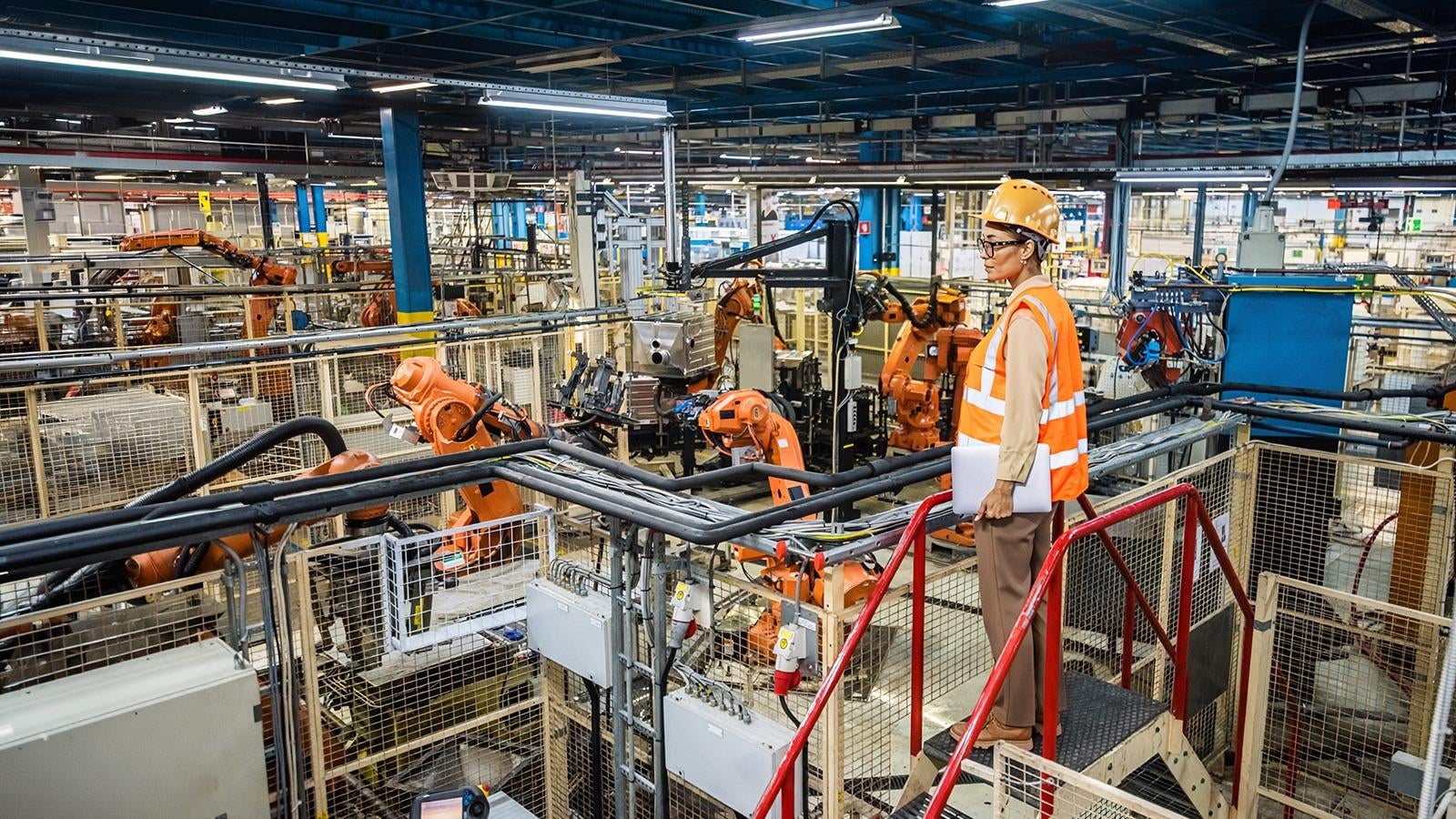
Industrial manufacturing’s race to 2030
Accelerating automation, AI adoption, and stronger ecosystem collaboration will define the winners—and leave others playing catch-up.
26 min read
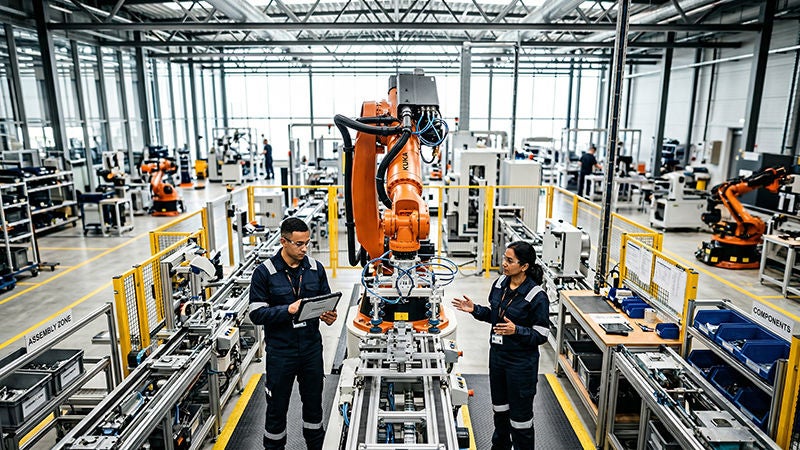
The three biggest GenAI priorities for industrial manufacturers
Companies are experimenting with isolated use cases in support functions, but the real value lies elsewhere.
3 min read

5 steps to redesign roles and build trust in the AI era
Agentic AI shouldn't be seen as a threat - but as a catalyst to reshape roles, upskill talent and unlock more meaningful human contribution.
5 min read
Get in touch

Stefan Schrauf
Global Supply Chain and EMEA Operations Transformation Co-Leader, Partner
PwC Germany

Sami Karttunen
Operations Transformation, Director
Strategy& Nordic

Andreas Odenkirchen
Data & AI, Director
PwC Germany

Khayala Eylazova
EMEA Operations Transformation, Senior Manager
PwC United Kingdom
