Turn insight into action
We help you solve the problems that matter most so you can act faster and move further.
What would you like to explore?
The future starts with what we build now
Why working backwards from an ambitious future can help organisations build valuable capabilities today.
The takeaways
- Frontier projects can generate valuable capabilities before they achieve their ultimate goal
- The journey towards a breakthrough can create as much value as the breakthrough itself
- Organisations that invest early are better placed to capture opportunities as they emerge. Science fiction is fantastic at giving directions
So many things we now take for granted, from instant wireless communication to cures for once-fatal diseases, were originally imagined in the pages of books or the scripts of movies. Sci-fi, more than maybe any other creative genre, does more than just entertain. It gives us permission to imagine entirely new technologies, cultures, and societies, and inspires us to make them real.
But for all its richness and wonder, science fiction is terrible at meeting deadlines.
That’s why I find the work of companies like Rendezvous Robotics so interesting. In our latest TED film, produced in collaboration with TED, Rendezvous Robotics co-founder Ariel Ekblaw talks about the challenge of space architecture. How can you scale up the size of what you build in space when you’re constrained by the cargo capacity of a rocket? Just as important, how can you drive the cost of space construction down so that it’s economically viable?
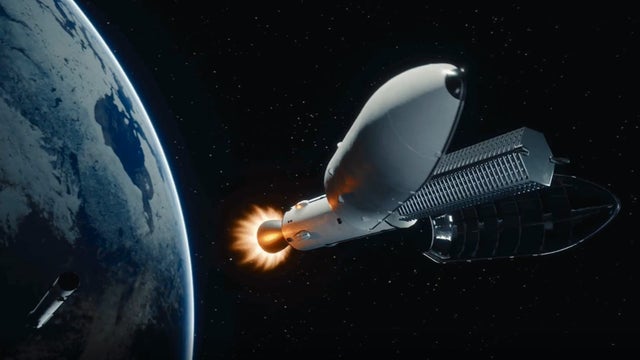
The answers, at least for Ariel, required thinking like a sci-fi author. She and her colleagues are designing swarms of autonomous “building blocks” which can all be launched in orbit separately. The modular hardware can then move together and interconnect magnetically. Onboard AI will oversee the process, check every connection, and even take the swarm apart and put it back together again if necessary.
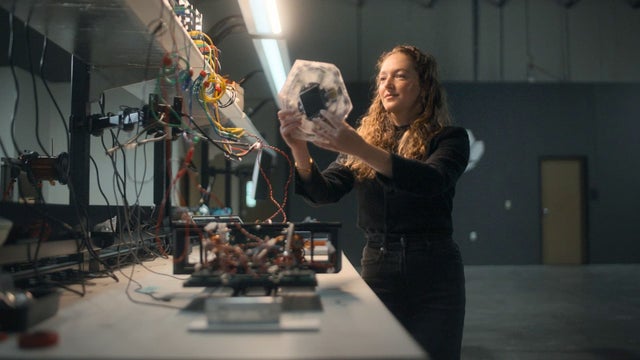
Nobody’s ever built an autonomously self-assembling spaceship before. The International Space Station is a modular design, but it took decades of research and design to figure everything out, and painstaking, intense work by astronauts in orbit to fit everything together. It was built to do one job – be a space station – and in the next few years it will be deliberately deorbited into the ocean once it reaches the end of its design life.
Rendezvous Robotics believes it can use new technologies to dramatically shrink costs (and timelines). Why? Because once you do that, you unlock all kinds of new uses for space.
They can see a destination in the future, so they’re planning their route to get there. I think it’s a useful model for any business leader who wants to prepare for how AI is going to reshape their industry or enterprise, but aren’t sure how to plan for what that’s going to look like.
Value arrives before the future does
On the surface, huge space stations might not seem particularly sensible. But orbital data centres are already beginning to move from idea to experiment. In October 2026, Google launched a prototype satellite for Project Suncatcher, its research programme exploring whether space could one day host scalable AI infrastructure.
The logic is compelling. Once you get past the tricky parts—launch and construction—there are lots of ways operation could be cheaper than at ground level. Most obviously, satellites in low Earth orbit can access near-constant sunlight, something Google is already exploring as part of Project Suncatcher.
It also means we move a huge amount of energy and resource-intensive infrastructure off-Earth, freeing it up for other uses.
This isn’t to say it’s an easy problem to solve, of course. Data centres can be the size of multiple football fields, and building, launching, and assembling something at that scale in orbit is definitely a challenge. But because we can see the destination, we can create a roadmap to get there.
It’s going to require detailed modular engineering, autonomous robotic swarm control, and AI that can handle the extremely complex construction of the final design. The AI needs to be an architect and a construction foreman, but it also needs to be able to handle every aspect of maintenance once it’s up and running.
So if something’s so complex, difficult, and potentially even impossible, why bother?
Because that’s what we do. It’s what humanity has always done. And our track record of doing the impossible is pretty good.
Frontier projects are never about just the destination. There will always be detours and challenges along the way—that’s how we move forward. For all the imagination and creativity of science fiction, there have also been countless discoveries made in the pursuit of something entirely different, and which nobody predicted:
- William Perkin practically invented the modern industrial chemical industry (and arguably changed the course of the entire fashion industry too) by mistake, when he accidentally created a mauve dye in 1856.
- Teflon’s unique properties—low-friction, high-heat resistance, chemically inert—revolutionised nearly every kind of industrial process after Roy Plunkett discovered it in 1938, even though he had initially just wanted to test out a few novel refrigerants.
- The hook-and-loop fastener was invented by George de Mestral after coming home from a hunting trip and trying to get plant burs off his dog’s fur. He thought tailors and department stores would be fighting each other to get their hands on it—except it was actually the aerospace industry that fell in love first. It’s especially useful in zero gravity (there was more than 20 square feet of hook and loop fasteners on Apollo 11 alone.)
Nobody can ever know everything in advance, but it’s still possible to create conditions that make discovery more likely. The best way to predict the future is to build it yourself.
Large-scale space-based infrastructure is probably still years away, but we still have to solve problems today to make the bigger goal possible tomorrow. If you’re a leader struggling to gauge uncertain returns on investment, don’t focus on the end of the timeline, when the product is ready for market. Try to focus instead on what new capabilities you’ll build along the way.

Working backwards from tomorrow
If you want some ideas for which frontier research areas of today will become ordinary infrastructure or products of the future, the sci-fi aisle isn’t a bad place to begin. On a more practical level, however, you should treat the future like you would a design brief. Find an outcome that’s just out of reach, and work backwards. Ask yourself: what has to change to make the future I want possible? Which capabilities do I need to develop? Are there existing technologies that I can bring together in a new way? What kinds of skills, materials, and safeguards do I need to do this responsibly?
By the time new opportunities are obvious, they’ll be obvious to everyone, and the organisations best placed to capture them will be those that have already spent years building up their foundations.
The future now arrives faster than ever. It’s time to get ready.
Related content