Turn insight into action
We help you solve the problems that matter most so you can act faster and move further.
What would you like to explore?
The competitive edge is hidden in your data
How AI can help organisations find and act on the signals others might miss.
Key takeaways
- More data does not always mean more value, but it can make it easier to spot the signals that lead to better decisions
Agentic AI can connect siloed knowledge and make it quicker to move from insight to action
AI will surface more information than ever before, but human judgement will always need to remain the ultimate
In elite sports, tiny margins can make all the difference.
Think of runners doing the 100 metres, with winners and losers separated by fractions of a second. Pole vaulters scraping over the bar by millimetres. Or tennis players winning a point with a shot that clipped a line by less than the width of a hair, something only a high-speed camera could detect.
But tiny margins also make a huge difference before those pivotal moments.
Take football. A professional scout typically watches around 2,000 players a year. This probably sounds like a lot, but it really isn’t—not compared to the hundreds of thousands, if not millions, of people in the world who kick a ball each day.
As Richard Felton-Thomas of AI-powered sports data analysis company ai.io puts it in our new film created in collaboration with TED, the number of athletes who could go on to top-level careers, but who never get spotted, almost certainly outnumbers those who do. It’s implausible to think there will ever be enough scouts to watch them all. The scale is too huge.
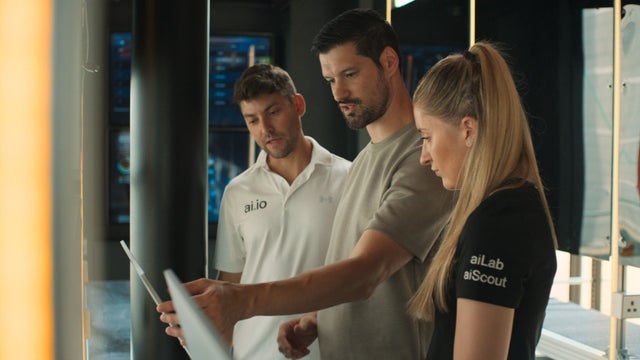
So he and his team set out to fix this with an app they call AiSCOUT. Any coach can ask their players to run through a set of standardised drills, and film how they perform. AI can then analyse their movements and attributes, and compare them against benchmarks based on a huge existing dataset of players.
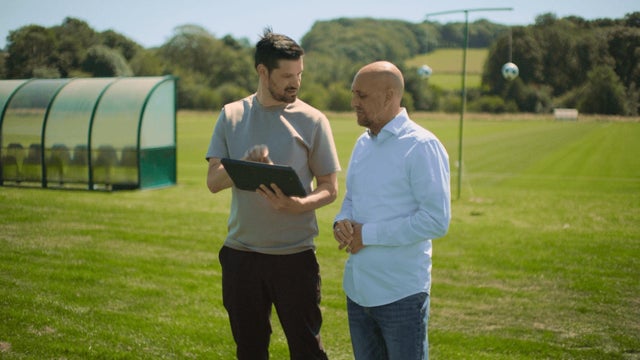
That analysis makes scouting scalable. Clubs can run trials for young players across entire countries, then bring that data together into a central scouting hub, where decisions on who to invite to the next stage can be made.
It’s a compelling story about how AI can widen access to opportunity. But I think it speaks to a more general business problem—when the margins between success and failure are small, how do you make sure you’re seeing the signals that matter among the noise?
It’s not just about having more data
It would be nice if the problem was just one of lack of data, but it’s actually the opposite.
According to Richard, sports teams may only have the capacity to use around five percent of their data for insights. They just don’t have the time, or the resources, to sift through everything.
That’s a familiar business problem. Decades into the information age, most organisations are drowning in bits and bytes. The challenge is increasingly about handling those firehoses of data in ways that are both efficient and useful.
We finally have tools that can process information at scales humans can’t, and begin to analyse it with something closer to the depth of human cognition.
In sports, scouts often talk about “the eye test”: a player might look good on paper, but it takes years of human experience to watch someone and instinctively know that they have what it takes. Richard’s team spent hours with scouts trying to quantify those ineffable insights.
What makes the height of a player’s jump “good”? What does it mean to kick “aggressively”? They couldn’t scale those tacit judgements until they understood what they actually were.
There’s a direct parallel inside most organisations. Some of your most valuable knowledge isn’t sitting neatly in a database. It’s distributed across functions, documents, systems, and people. In bulk, it’s often under-utilised because it’s both too vast and too diffuse.
The opportunity is to become much more deliberate about the signals you collect, the questions you ask, and how decisions are made in response. Once institutional knowledge is structured in a way that AI can interrogate, you unlock far more of its value.
Your data shouldn’t just be a repository of information. It needs to be accessible and comprehensible enough for AI to narrow everything back down to the factors that matter most.
Agentic-powered, but still human-led
Agents make this kind of knowledge scaling even more viable. In our transformation work, we’re already seeing delivery being accelerated by 30 to 50 percent as agents increasingly connect multiple tasks together and run them in parallel.
They can take on research, analysis, and information-gathering that have previously taken up human time. That’s freeing people to move up the pyramid, to focus more on innovation, creativity, and, most importantly, judgement.
The decision cycle in any organisation is simple: observe, understand, decide, act. Increasingly, AI’s role is to compress the first two stages. Leaders can use the time saved either to make decisions faster, or to spend longer considering the options before acting.
Both can generate value. But there’s a danger in confusing first-mover advantage with a structural, permanent advantage. Data is becoming easier to gather and sort, while AI tools continue to mature and spread.
Again, sports is a great example here. Billy Beane’s application of sophisticated data analysis to baseball scouting—the story told in Moneyball—helped the Oakland A’s punch well above their weight for a few years, but then everyone else learned from their example.
If every club has access to the same kinds of information and tools, then it comes down, again, to humans. It comes down to the human ability to understand mentality, and grit, and to spot when someone has “it” where others don’t. Those aspects of sports, and of everything, which can’t necessarily be quantified, or where ultimate responsibility must remain in human hands for the sake of integrity.
Business leaders should think about AI-enabled decision-making in the same way. Which signals are you missing? Are the people making decisions being given everything they need to make the best decisions possible?
It’s a tricky balancing act. Scaling up your raw knowledge, but also building the infrastructure to distil that knowledge into everything that decision-makers need—and no more.
That’s where the real competitive advantage will be won. AI will make data, analysis, and even expert-level capability increasingly ubiquitous, so simply having access to the technology won’t be enough. The winners will be the organisations that can turn all of that intelligence into better decisions, faster, and without sacrificing the human judgement that gives those decisions context and accountability.
In sport, the difference between first and second can be a fraction of a second. In business, the margins may be harder to see, but they are no less decisive. AI can help you find them. The question is whether your organisation is built to act on them before someone else does.
Related content