Turn insight into action
We help you solve the problems that matter most so you can act faster and move further.
What would you like to explore?
AI is accelerating the economics of innovation
Advances in drug discovery demonstrate how every sector can learn to move at AI speed
The takeaways
- AI’s biggest competitive opportunity may be accelerating innovation, not simply automating existing work
- Human expertise becomes more valuable when AI can apply and amplify it at far greater scale
- Faster discovery only creates value if plugged into a business model that can keep up
Business leaders often talk about the need to constantly evolve in order to outpace the competition. In antibiotic research, it’s meant literally.
Developing a new antibiotic takes, on average, around 13 years, but it can take as few as six years for bacteria to develop resistance in response. It’s the kind of problem we might otherwise euphemistically describe as a fundamental mismatch in innovation cycles. In the war on disease, we’re building ships that are being sunk almost as soon as they leave the harbour.
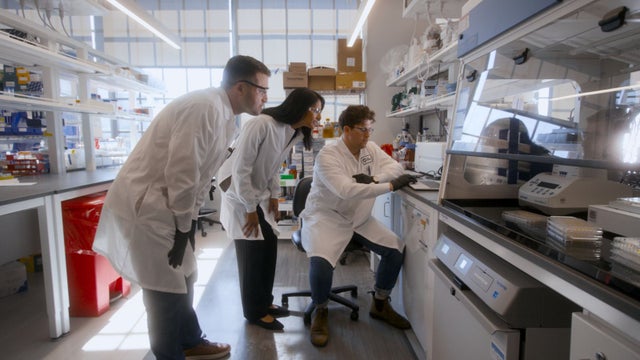
Are we really doomed to fight a losing battle, though? Of course not. Look at what Phare Bio is doing in our new film, created in collaboration with TED. They tested how well a range of compounds could or couldn’t kill bacteria in the lab, then trained an AI model on those results. The model was then able to extrapolate that training data into a novel antibiotic.
Instead of searching for a needle in a haystack, it meant that they could, in the words of CEO Akhila Kosaraju, “design our own needles.” Six years since that first experiment, AI continues to accelerate their drug discovery processes, with huge boosts to productivity and speed, without compromising scientific rigour.
But I think there are lessons here that apply well beyond healthcare. It’s a demonstration of how AI is changing the economics and speed of innovation everywhere.
For example, just as Phare Bio's applied AI moved beyond searching existing drug libraries to inventing new molecules, for utilities providers AI can move beyond forecasting demand to designing entirely new grid configurations, pricing models, and storage strategies in real time. What once required years of pilot programs and simulations can now be compressed to days. Once again, AI becomes an innovation engine - not just a tool for automating meter readings or optimizing billing.
Speed limits are increasing
Phare Bio’s first generation of AI could only search existing libraries and databases to identify promising drug candidates. The real revolution then came with generative AI, which can invent new molecules, not just assess existing ones.
It demonstrates how AI is moving us well beyond the usual automation framework, where a technology takes on responsibility for a task or process to increase speed or reduce costs within an otherwise-unchanged business model. AI has become an innovation engine in itself, not just an efficiency tool.
AI has both boosted Phare’s overall research capacity and sped it up, shrinking the timeline from idea to execution to days or weeks, where before it was months or even years. AI’s value might not seem obvious when looking at its impact on any one point in a process, but step back to measure the big picture outcomes and the impact is extremely clear.
Every leader needs to be prepared to see the innovation cycle in their own industry compress in a similar way. And, when it inevitably does, can you take advantage of it? Because the winners will be those who can move from idea to test to refining to commercialisation faster than the rest. The gap between those at the front, and those left behind, will quickly compound.
More experts, more expertise
Humans become even more important in this context.
At no point does a drug discovery AI operate in isolation. The entire journey requires a continuous loop of chemists, microbiologists, computational scientists, and machine learning scientists, and the AI working together. Human expertise gathers the training data, it tunes the model, it evaluates the outputs, and it tests those outputs physically, in a petri dish. The evidence from those tests is then fed back into the model to improve the next iteration.
And, of course, it’s humans who have the final oversight of this entire cycle. Humans have to check the quality of the work, and it’s humans who are ultimately responsible for ensuring that any research conducted under this model still adheres to the highest possible standards for scientific enquiry.
AI changes the economics and structure of human expertise—it moves human judgement towards the areas where it has the greatest value, to focus it. As Akhila says, “we can now take one chemist and turn them into 101,000 chemists.” There’s simply too much value in human experience and judgement to simply replace it with AI.

Leading through collaboration
There’s also a lesson here about our place, as humans, within the broader ecosystem of innovation.
We need to not just scale within our own businesses and organisations, but within our industries, and our societies. It may become increasingly difficult for any one entity to produce enough information to feed this innovation flywheel, or to have enough people on hand to keep it spinning. Think beyond your own four walls, including potential research partnerships. AI can’t democratise access to innovation and discovery if its outputs are restricted to just a single institution or company.
In a lot of cases, the competitive advantage in a sector will depend less on trying to own every step yourself. It’ll come from being the conductor of an orchestra of data, technology, expertise, and human relationships, all playing in harmony. The organisations that do this well will be those that combine the right partners, capabilities, and governance, creating the conditions for trust both within and beyond their organisation.

The whole picture
The overall picture is pretty clear - speed doesn’t necessarily equal value. There’s no point churning out new antibiotics if you haven’t got the capacity to test them in a lab, or run trials with patients, or that you can’t ensure the overall scientific integrity of your research. Those fundamental principles come from humans, not machines, and the ecosystem of science and technology cannot continue to function without them.
Use AI as a tool for widening existing bottlenecks, and you’ll only move the bottlenecks elsewhere.
We’ve seen this with clients who have been most successful with AI adoption. They’re thinking end-to-end, not process-by-process. They focus on the outcomes they want to see, and then restructure their processes, their people, and their partnerships to that end. What actually needs to change? Which skills do you need, and who can help you build? Where does judgement sit, and who are your judges?
Those are the questions leaders need to answer to win the battle to turn ideas into outcomes, not just efficiencies.
Related content