Turn insight into action
We help you solve the problems that matter most so you can act faster and move further.
What would you like to explore?
Unlocking new value through domains of growth

Nine interconnected economic zones promise trillions in revenue—for companies that can make reinvention a capability.
The takeways
- Domains of growth offer a new map for value creation as industries converge around fundamental human needs.
- Technology—especially GenAI—can help companies reinvent faster, modernise operations and reset customer expectations.
- Winning will depend on trusted cross-sector partnerships that close capability gaps and unlock new markets.
It’s the potentially trillion-dollar question: Where should business leaders place their bets in a world where industries are converging, markets are rapidly evolving and disruption is the only constant?
As forces ranging from AI-driven innovation to climate upheaval push companies to change how they create, deliver and capture value, an estimated $7.1 trillion in revenue is up for grabs this year alone, according to PwC research. To seize the opportunity—and the trillions more in play annually over the next decade—organisations must reorient their business models. The focus: domains of growth—market opportunities in which companies work across sectors to address fundamental human needs.
$4.4Trillion Value of market share that will change hands in 2025 from business model reinvention
Source: Duffey, Matthew, Kazi Islam, Carol Stubbings, and Matt Wood, “Reinventing your company for growth,” PwC, April 29, 2025.
“Possibility comes from partnerships. It’s important to break down silos within industries and shift to a more holistic view,” says India Hardy, global health industries partner at PwC. “You can unlock significant value by building on the resilience of other brands. You’re not just relying on your own organisation to achieve growth—you’re building on the strengths of others.”
The nine domains shaping the future
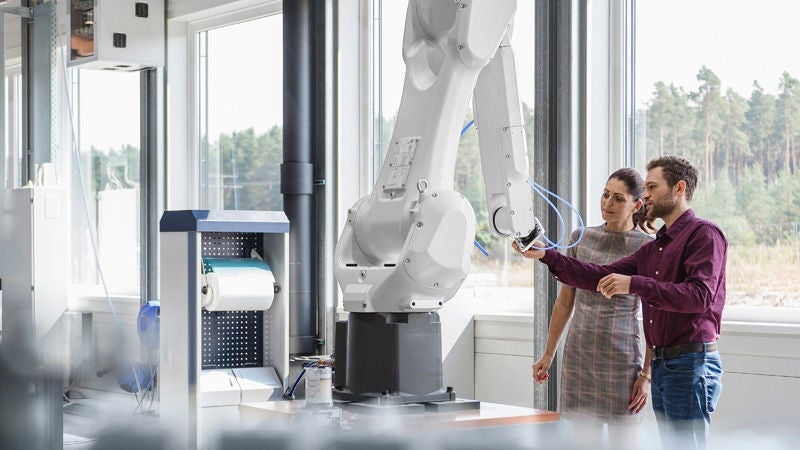
PwC has identified nine domains of growth, each centered around a different human need. For example, the “How We Make Things” domain highlights how manufacturers and suppliers can pool capabilities and knowledge to create innovative offerings that better meet customers’ needs. Consider how a provider of clean energy services could unlock value by partnering with manufacturers to leverage data sharing, renewable energy standards, and cross-border energy and carbon trading. Or how a manufacturer might team up with a tech player to create an “as a service” offering to provide remote monitoring and predictive maintenance.
Elsewhere, in the “How We Move” domain, mobility players use clean tech and digital solutions to meet the need for safe, efficient transportation. Automotive makers might partner with tech brands to develop multipurpose autonomous vehicles for both work and leisure. This domain, says Harald Wimmer, senior partner at PwC Germany, is shifting from being “predominantly mechanical engineering defined to being predominantly software engineering defined. The only way to master it is to form an ecosystem that encompasses technology players previously not engaged in mobility.”
The nine domains of growth
Make: To meet the world’s need for materials and industrial goods, manufacturing must reinvent itself through innovation, digitisation and automation.
Build: Our need for places to live and work is growing—and changing. To meet it, industries are converging on innovative ways to build.
Feed: The agri-food system is at a pivot point. Feeding 10 billion people at mid-century will require a cross-sector push for innovation in the decade ahead.
Care: As the world confronts medical challenges, the healthcare sector must provide care at scale that is effective, affordable, preventative and personalised.
Move: To meet customers’ needs for safe, efficient, affordable transportation, mobility players are tapping into clean tech and digital solutions.
Fuel and Power: To facilitate clean and reliable access for a rising population and enable industries to meet demand, the energy sector must embrace new ways of operating.
Govern and Serve: By supporting collaboration between sectors, governments can help improve well-being and advance prosperity.
Fund and Insure: Capital is a vital catalyst for growth. How it’s deployed, managed and insured must evolve along with the industries it serves.
Connect and Compute: Business collaboration increasingly runs on technology. And the businesses developing that technology must increasingly collaborate to thrive.
Collaborative opportunities like these make domains more than a thought exercise for today’s leaders. In fact, this focus can provide a springboard for innovation and successful business model reinvention. “Without a domain mindset, you risk stifling innovation and not achieving your full growth potential,” Hardy says. “And from a balance sheet perspective, you can find yourself with assets that have reduced value in a reconfigured world.”
Make your organisation domain-ready
Not all businesses are prepared to become players within domains. Companies perform progressively—today’s performance is the foundation for tomorrow’s—so some are better positioned to thrive in the future. A PwC analysis finds that in terms of winning performance traits, the top 20% of organisations capture more than 80% of profitable growth. For those on the outside looking in, it’s important to adopt practical strategies for making up lost ground and competing more effectively.
One approach is to compete on technology. PwC research shows that using generative AI—both for efficiency and for transforming workflows, processes and business models—could boost operating margins by double digits. First, though, companies must shore up the basics: reducing technical debt, eliminating legacy IT, embracing cloud technology and modernising data. “The breakneck pace of GenAI adoption and the encouraging business results offer an early indication of the technology’s promise,” says Ryan Hawk, global industrial manufacturing and automotive leader at PwC. “Fast movers won’t just gain an edge—they’ll reset the baseline for customer experience, putting pressure on the rest of the market to follow.”
Look for those you can collaborate with across domains and reinvent your business model in partnership with them.
India Hardy, Global Health Industries Partner, PwC
Organisations should also prioritise building trust with collaboration partners, which will only prove more essential over the next decade as companies deploy advanced technology and manage increased complexity at speed. Instilling confidence in cross-sector partners can foster deeper collaboration, lower transaction costs and ultimately unlock greater value.
Consider, too, capabilities that are directly linked to value creation. Ecosystem cultivation in particular can open the door to further capability development. According to PwC research, top-performing organisations are 1.6 times as likely as other companies to use ecosystems for finding new customers and markets, taking advantage of insight-heavy data, and identifying complementary skills and capabilities.
Collaborate in pursuit of value
A decade of groundbreaking innovation and industry reconfiguration awaits, organised around domains that promise monumental rewards. Companies must reimagine not just how they compete, but also where growth will emerge. For executives, this means creating cross-sector partnerships to help succeed on trust and technology, address capabilities gaps, and transform business and operating models.
Hardy offers advice for leaders as they navigate this exciting new era: “Stay informed and be agile. Widen your focus by looking for those you can collaborate with across domains and reinvent your business model in partnership with them. Yesterday they might’ve been competitors—tomorrow they can present opportunities.”
Related content

Rethinking Reinvention
A collection of articles, executive interviews and podcast conversations that explores how leaders are navigating disruption, embracing transformation and creating competitive advantage through reinvention.

Reinventing your business? Here’s why tax matters.
Explore how effective tax evaluation doesn’t just help balance costs and risks—it unleashes profit and innovation.
3 min read

A new imperative for business model reinvention
Explore the necessity of continuous business model reinvention. Learn how customer focus, data insights, and collaboration drive innovation and global growth.
7 min read
Six factors that determine when to reinvent
With business model reinvention, timing matters. These key indicators can serve as a harbinger of industry disruption.
5 min read

Three AI moves to future proof your company
Early adopters won’t just gain an edge—they’ll set a new standard for delivering customer value.
7 min read
Get in touch

Matthew Duffey
Global Business Model Reinvention Leader
PwC United States
Matt is a US principal with over 20 years of strategy and operations consulting experience in the technology, media, and telecommunications sectors.

Angelo Estrera
Asia Pacific Americas Reinvention Leader, Partner
PwC Australia
