Adam Kňaze
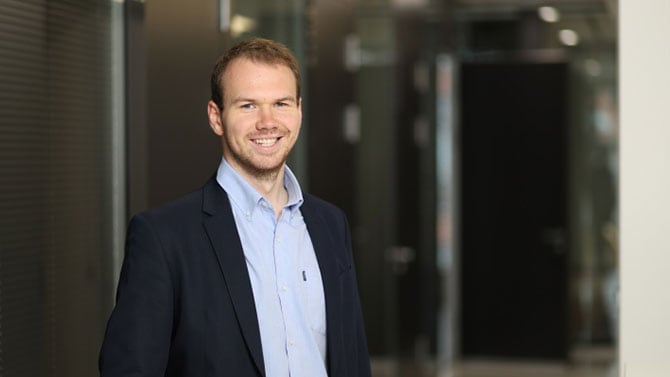
Adam Kňaze is a Senior AI and Data Analytics Consultant in PwC’s Advanced Technology Solutions team. His work mainly focuses on computer vision and the processing of visual data, such as satellite and aerial imagery. Using AI and geospatial data, he helps clients understand what is happening on the ground in real time.

You are part of the AI team. How do you use AI in your work?
Our team focuses on digitalisation and automation. We aim to replace repetitive tasks with computer‑based processes, to reduce manual processes. Traditional procedures and algorithms have their limits, and that is where AI becomes essential.
Can you give us a concrete example of how you use AI?
We have worked with aerial imagery covering the entire country on some projects. Slovakia is not a large country, but imagine checking every square metre manually. With AI, tasks that used to be performed manually can now be fully automated.
So you teach AI to take over tasks previously carried out manually?
The key word here is “teach”. That is the main difference between AI and classic algorithms. An algorithm does exactly what you tell it to do. You give the computer a list of instructions.
AI works differently. You create a programme capable of learning on its own. Then you show it many examples. You feed it the inputs, and it produces outputs. At first, the outputs may be completely wrong. But you correct them by telling the model what the right answer should have been. Based on this, it adjusts its parameters, so that next time the result is better.
How long have you been working with AI?
Our specialised AI team has existed for about five years. I have been part of it for around three years.
What is the difference between the AI you use and popular open AI platforms such as ChatGPT?
Our models are usually designed for one specific task. For example, with satellite images, we have an AI model that recognises buildings and other structures. It can tell which area is a forest, and which area is something else. It has one purpose and is trained exactly for that.
Models such as ChatGPT are more general. Developers have trained them on an enormous amount of data with a simple task: predict the next word in a sentence. Once trained, they test what other tasks the model can perform. Such systems are powerful because of their versatility, but it’s harder to understand why they produce certain outputs. They are less transparent.
Are you worried that freely available technologies will soon replace your solutions?
Not really. The question is how long these technologies will stay freely accessible. Running the servers behind them is expensive and someone will eventually need to cover the cost. Many of these features will become part of commercial tools we already use. For example, MS Office will soon automate many tasks we used to do manually. Email clients will be able to draft emails for you.
On the other hand, traditional business will always need customised solutions. That is what we focus on and will continue to do.

Will AI replace people? Should employees be worried?
Some people probably should be. Repetitive tasks with low added value will be replaced to a certain extent. But humans are still better at adapting to new situations and solving unforeseen problems. We can explain our reasoning and justify our decisions. For now, that gives us an advantage.
In your Satellite Monitoring work, you undertook a project for the water industry. Can you tell us more?
In Slovakia, you pay for rainwater if it goes into the sewer system. When it rains and water falls on grass or soil, it is absorbed. But when it falls on asphalt, a roof or another hard surface, it usually ends up in the sewer and later in a treatment plant. This is billed as wastewater.
To calculate how much rainwater went into the sewer, you need to know the area of hard surfaces on a property. Water companies often lack accurate data on this. Using aerial and satellite imagery combined with AI, we can detect surface types anywhere. Once we have the data, we combine it with records from the land registry, water companies and information provided by property owners. If someone reported a built‑up area of 50 m2 but the real area is 200, we can show the client where the discrepancies are.
If someone wants to join your team, do they need a technical degree?
A technical background is necessary because we build technical solutions. When a client comes to us with a problem, we design the solution and undertake implementation. For AI specifically, interest in the topic is important. A good overview of data analytics is also helpful. You can learn this by self‑study, but university programmes make it easier.
What do you enjoy most about working at PwC?
I enjoy the work because of the team and the variety of tasks. I get involved in everything from implementation and design to client communication. When one of my projects reaches the production stage, I also act as the product owner. This broad scope of work is what I like most.
Consulting or a purely technology‑focused company?
Technology consulting has the advantage of variety. You try many different things. In a purely tech company, you often work on one product that the company develops, and you stay with it long term. In consulting, you encounter different sectors and technologies. Some projects last a few months, others several years.
If I had stayed just as a programmer, I would have probably improved my programming skills faster. But the role would be much more narrowly focused. At PwC, you learn quickly and constantly. For example, before joining, I’d never worked with satellite imagery. My team leader showed me a project and said it might be interesting to explore satellite data. “See if there is something useful there,” was the task. I had to learn how satellite images work, how to handle geospatial data and much more. If you like learning new things and enjoy variety, consulting can be very satisfying.
Do you have a dream project?
Any project where I can design a solution completely from the beginning and feel a real sense of ownership. The most important and meaningful part for me is seeing that the project creates real value.
Currently open positions
Contact us